How to Apply for the PMP Exam in 2026: Step-by-Step Guide
Learn how to apply for the PMP exam in 2026, from checking your eligibility and documenting project experience to handling a PMI audit, paying the exam fee, and scheduling your test.
Applying for the Project Management Professional (PMP)® certification in 2026 involves more than simply choosing an exam date.
Before PMI allows you to schedule the exam, you must demonstrate that you meet the certification requirements and accurately document your education, project management training, and professional project experience.
The application itself becomes much easier if you prepare that information before you start.
This guide walks through the PMP application process step by step, explains what PMI expects when you describe your project experience, shows what happens if your application is selected for audit, and explains what happens after your application is approved.
Quick answer: Check that you meet the PMP eligibility requirements, prepare your education, training, and project-experience information, submit your application through PMI, complete an audit if selected, pay the certification fee after approval, and then schedule your exam.
If you have not yet confirmed that you qualify, start with our PMP eligibility requirements for 2026.
PMP application process in 2026
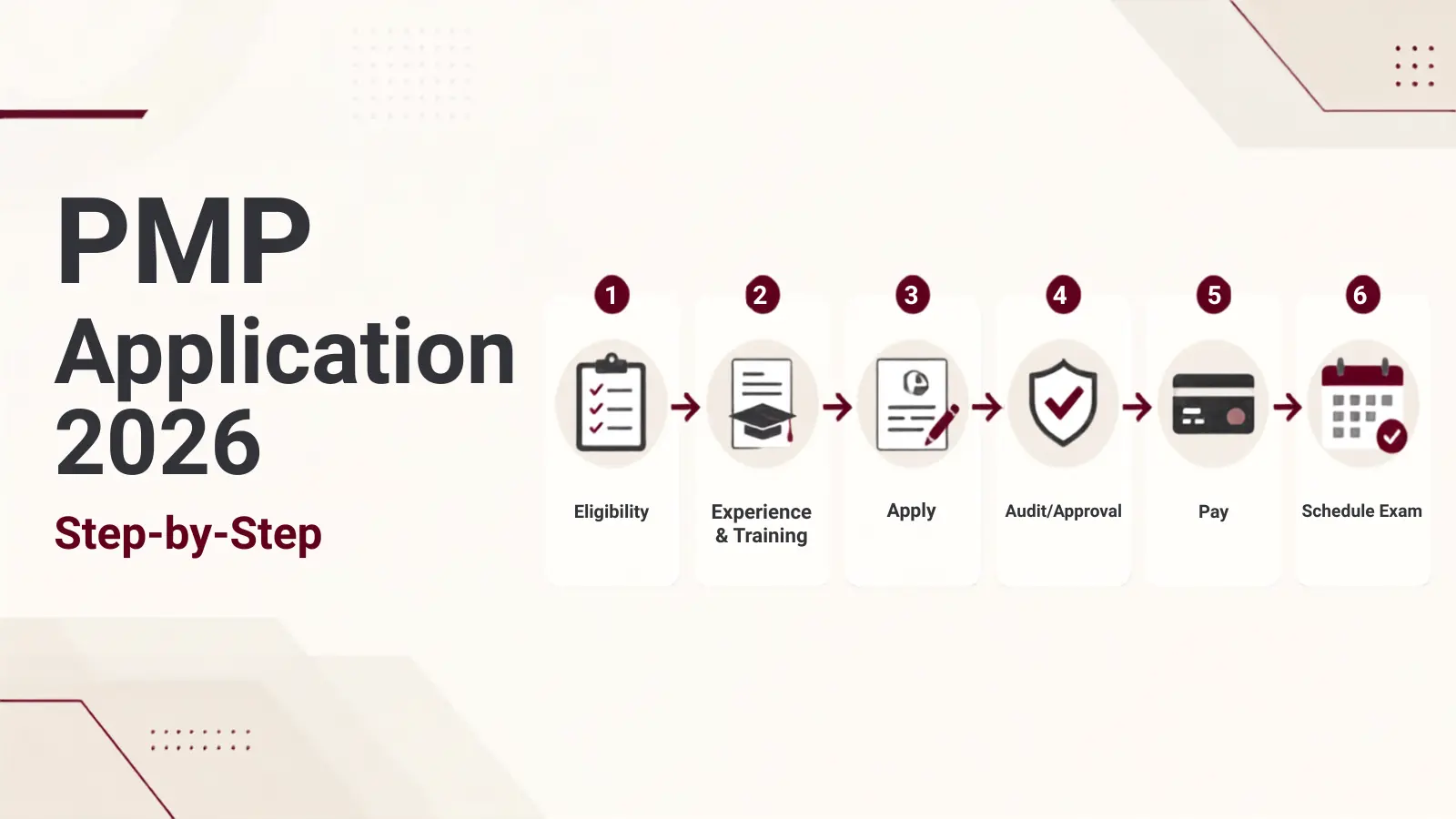
The overall process can be summarized in seven steps:
- Confirm that you meet the current PMP eligibility requirements.
- Gather your education and training information.
- Map your professional project experience.
- Complete and submit the PMP application through PMI.
- Complete the PMI audit process if your application is selected.
- After approval, pay the PMP exam fee.
- Schedule and prepare for your exam.
Each step matters, especially the way you describe your professional project experience.
Step 1: Confirm that you are eligible before applying
Do not begin by trying to make your experience fit the application form.
First, confirm that you actually meet one of PMI's current eligibility pathways.
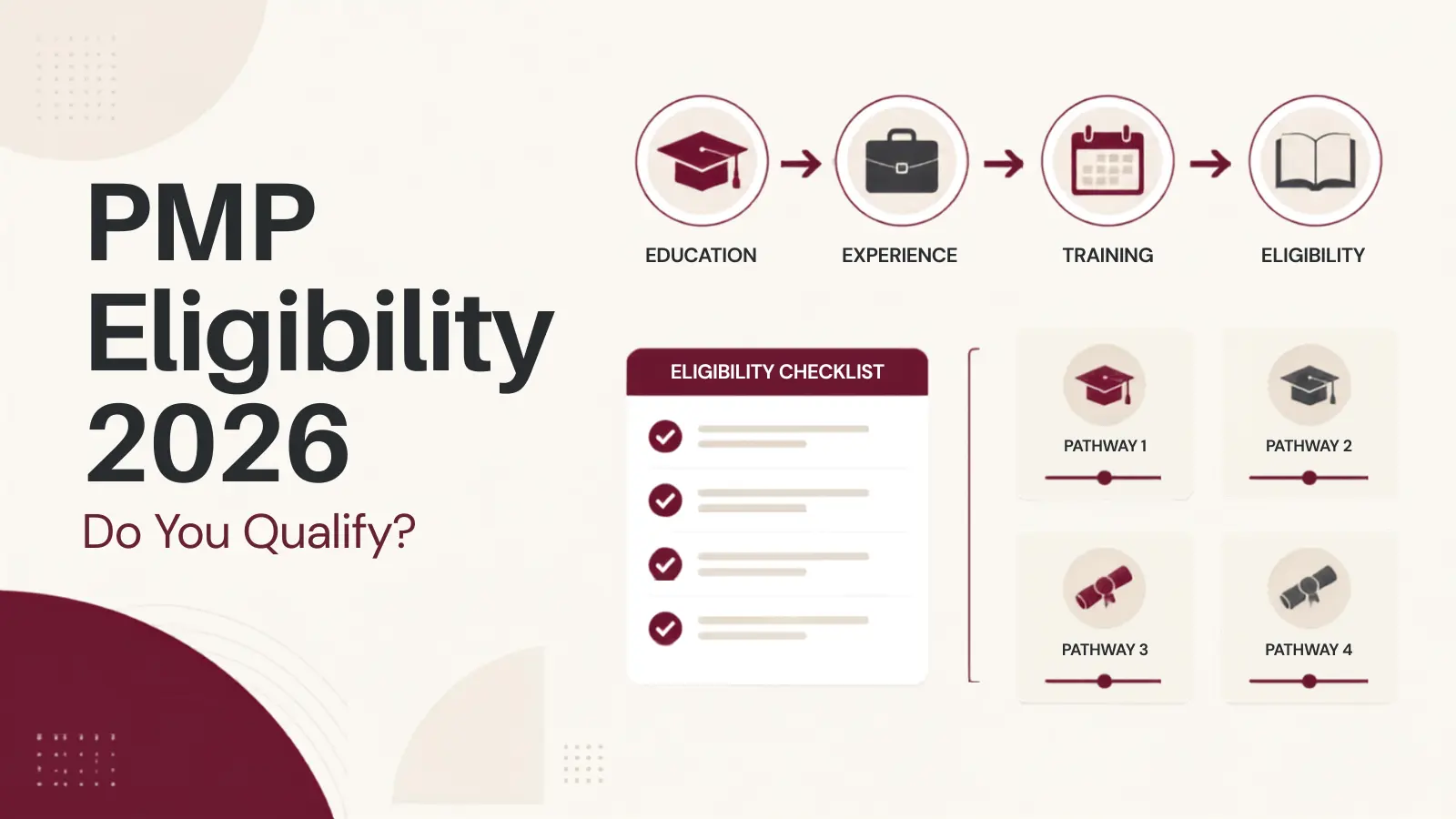
The 2026 requirements combine your educational background with a minimum amount of professional experience leading projects.
| Educational background | Project leadership experience |
|---|---|
| Secondary / upper-secondary education or equivalent | 60 months / 5 years |
| Eligible associate-level or technical/vocational qualification | 48 months / 4 years |
| Bachelor's degree or higher, or qualifying bachelor-equivalent credential | 36 months / 3 years |
| Degree from a PMI GAC-accredited program | 24 months / 2 years |
Your qualifying project experience must have been gained within the 10 years before you submit your application, and overlapping project months cannot be counted twice.
You also need 35 hours of qualifying project management training, unless you qualify for an applicable credit such as holding an active CAPM® certification.
For a detailed explanation of these pathways, see our complete guide to PMP eligibility in 2026.
You should also compare your situation against PMI's current PMP certification requirements before submitting.
Step 2: Gather your information before opening the application
A little preparation can prevent a lot of confusion later.
Before filling in the PMP application, collect the information you will need to support your eligibility.
For your education, have the correct name of your institution, your qualification, and the relevant completion information available.
For your project management training, keep records of the courses you are relying on to satisfy the 35-hour requirement.
These records may include:
- course names;
- training providers;
- completion dates;
- certificates or letters of completion;
- number of qualifying project management training hours.
If you hold an active CAPM certification and are relying on that credential to satisfy PMI's PMP training requirement, make sure your certification status is current.
Keeping these records organized is especially useful if your application is selected for audit.
Step 3: Map your project experience before entering it
This is one of the most important steps in the application process.
PMI requires you to record your professional experience leading and directing projects.
Before entering projects into the application, create your own simple project timeline.
For each project, record:
- project name;
- organization;
- start and end dates;
- your role;
- the objective or intended outcome;
- the responsibilities you personally handled;
- the people or stakeholders you led or coordinated;
- significant delivery, governance, or decision-making responsibilities;
- the final outcome or transition.
This exercise helps you see whether your projects meet PMI's requirements and whether any project periods overlap.
PMI counts experience in months, not by the number of projects completed.
If two projects occurred during the same months, those months only count once toward your eligibility total.
For example, if one project ran from January through June and another ran from April through September, you do not have 12 months of experience.
Your elapsed experience covers January through September: 9 months.
PMI's current guidance on PMP project experience explicitly warns candidates not to double-count overlapping months.
Step 4: Describe what you did, not just what the project was
One of the most useful principles when completing the PMP application is this:
Your application is about your project leadership experience, not a detailed description of the product or project.
PMI wants to understand what you personally did.
A weak description focuses almost entirely on the project:
The project implemented a new enterprise system for 2,000 employees across multiple departments.
That tells PMI what the initiative was, but very little about your contribution.
A stronger description explains your role:
Led planning and coordination for the implementation workstream, aligned requirements with business stakeholders, tracked delivery risks and dependencies, coordinated project communications, supported governance decisions, monitored deliverables, and managed transition activities through project closure.
The goal is not to fill your description with project-management terminology.
The goal is to communicate your actual responsibilities clearly and accurately.
PMI's August 2026 application guidance recommends making your role, contributions, and outcomes clear. It specifically highlights elements such as the project's objective, governance or decision-making, tracking deliverables or outcomes, and closing or transitioning the work.
Focus on project work, not routine operations
Your application entries should describe projects.
Routine operations and administrative activities should not be presented as project-management experience.
For example:
Routine operation: managing the same monthly reporting process indefinitely.
Potential project: leading a temporary initiative to redesign that reporting process, define requirements, coordinate stakeholders, implement the new solution, manage the transition, and close the initiative once the defined outcome is achieved.
The distinction is important because a project has a temporary nature and a defined objective or outcome.
School projects, personal events, home-improvement projects, and academic research completed for a degree program do not qualify as professional PMP project experience.
You do not need the job title "Project Manager"
Your job title does not determine whether the experience qualifies.
PMI's current guidance explicitly states that candidates do not necessarily need to have held the title "Project Manager."
You may have qualifying experience while working as a:
- project coordinator;
- business analyst;
- engineer;
- consultant;
- implementation manager;
- PMO professional;
- team lead;
- product or operations lead;
- technical lead.
The important question is whether your professional responsibilities involved leading and directing project work.
Likewise, having the title "Project Manager" does not automatically mean every activity you performed qualifies.
PMI evaluates the experience you describe.
Step 5: Enter your education and training accurately
The PMP application also records the education and training you are using to satisfy the certification requirements.
Enter information exactly and keep supporting evidence available.
For the project management training requirement, PMI's July 2026 Examination Content Outline states that candidates generally need at least 35 hours of qualifying project management training aligned with the PMP Exam Content Outline.
Training can cover subjects such as:
- scope;
- schedule;
- communications;
- risk;
- procurement;
- financial management;
- resources;
- stakeholder management;
- integration;
- governance.
Books and practice exams alone do not satisfy the training requirement.
An active CAPM certification can satisfy the PMP training requirement, subject to the other PMP eligibility requirements.
See the official 2026 PMP Examination Content Outline for PMI's current eligibility and training rules.
Step 6: Review everything before submitting
Before clicking Submit, review your application carefully.
Check that:
- dates are accurate;
- overlapping project months have not been double-counted;
- project entries describe professional project work;
- your responsibilities are truthful;
- your education information matches your supporting documents;
- your training information matches your certificates;
- there are no exaggerated claims;
- project descriptions clearly explain your own role.
Do not try to make the application sound more impressive than the work actually was.
A clear and accurate application is much easier to support if PMI later asks for verification.
Step 7: Submit the PMP application to PMI
The PMP application is submitted through PMI.
Use PMI's official PMP certification page rather than third-party sites:
Start from the official PMI PMP certification page.
Once submitted, PMI reviews the application and determines the next step.
Your application may proceed normally, or it may be selected for an audit.
An audit does not automatically mean that PMI believes something is wrong with your application.
PMI states that all applications are subject to audit and that a percentage are selected.
What happens if your PMP application is selected for audit?
If your application is selected for a PMI audit, you will be notified before payment of the certification fee.
PMI may require supporting documentation including:
- a copy of your diploma, degree, or equivalent educational credential;
- verification from supervisors or managers for the professional experience listed on your application;
- certificates or letters from training providers for the project management education you reported.
PMI currently gives candidates 90 days to submit the requested audit documentation.
According to the current PMI Certification Handbook, once the required documentation has been received, an audit should generally take around 5–7 business days to complete.
You cannot continue to the next certification step until the audit requirements have been completed.
The official PMI Certification Handbook is the best reference for current audit procedures and certification policies.
How to prepare for a possible PMP audit
You should prepare for an audit before submitting your application, even though you may never be selected.
That simply means ensuring that the information you submit can be verified.
Keep:
- copies of your education credentials;
- project dates;
- names and contact information of people who can verify your project experience;
- training certificates;
- course records;
- any other documentation relevant to the information entered on your application.
Most importantly, make sure the people who could verify your experience would recognize the responsibilities you have described.
Do not list leadership responsibilities that you did not actually perform.
What happens after your PMP application is approved?
Once your application is accepted, the next major step is payment.
PMI's current PMP guidance states that after your application is accepted, you pay the certification exam fee and then schedule the exam.
The exam fee itself deserves separate treatment because membership status and current PMI pricing can affect the amount you pay.
We cover that separately in our upcoming guide to PMP exam cost in 2026.
After PMI receives your certification fee, the Certification Handbook states that PMI sends an eligibility notification containing your PMI Eligibility ID, which is used when scheduling the exam.
How long do you have to take the PMP exam after approval?
Once your application has been approved, PMI provides a one-year exam eligibility period.
During that period, you may attempt the PMP exam up to three times.
If your application was selected for audit, PMI states that the one-year eligibility period begins when you are informed that you successfully completed the audit.
Do not interpret that one-year period as a recommendation to wait a year before taking the exam.
It is simply the eligibility window.
Your actual exam date should depend on your preparation and readiness.
For an overview of the current exam itself, read our PMP Exam 2026 changes guide.
When should you schedule the exam?
You should schedule once your application has been approved, the fee has been paid, and you have a realistic preparation plan.
Avoid choosing a date simply because you are eager to get the process finished.
Before scheduling, consider:
- how much of the 2026 Examination Content Outline you have covered;
- your performance on realistic practice questions;
- your weak domains and topics;
- whether you have completed full-length practice;
- how much study time you can consistently maintain before exam day.
CertOnyx's PMP preparation area is designed around the current PMP exam and can help you practice once you reach the preparation stage.
Common PMP application mistakes to avoid
Several avoidable mistakes can make the application process harder.
Double-counting overlapping projects
PMI counts months, not the number of projects.
If projects overlap, the overlapping months only count once toward your required experience.
Writing about the project instead of your role
PMI needs to understand what you led and directed.
A long description of the technology, customer, budget, or product does not replace a clear explanation of your responsibilities.
Including routine operational work
Ongoing administrative or operational responsibilities should not be presented as temporary project work.
Exaggerating responsibilities
Your application should be accurate enough that a supervisor or manager could verify the experience if PMI requests confirmation.
Using unclear dates
Create a project timeline before completing the application.
This makes it easier to identify gaps and overlaps.
Assuming your job title determines eligibility
PMI evaluates your experience, not simply your title.
Applying before you meet the requirements
If you are short of the required experience or training, complete the missing requirement before applying.
Example of preparing a PMP project entry
Imagine that you helped deliver a company-wide customer relationship management system.
Instead of starting with a technical description of the CRM platform, structure your notes around your project role.
Project objective
Implement a new CRM solution across sales and customer-service teams.
Your role
Led the business implementation workstream and coordinated internal stakeholders.
Responsibilities
Gathered requirements, supported planning, coordinated stakeholders, tracked risks and dependencies, monitored deliverables, escalated issues through governance, supported user readiness, and coordinated transition activities.
Outcome
The solution was deployed and transitioned to operations according to the agreed implementation plan.
The final wording you enter in PMI's application should reflect what you genuinely did.
This preparation method simply helps you organize that information before you begin writing.
Should you use AI to write your PMP application?
AI tools can help you organize notes, improve clarity, or identify whether a description is difficult to understand.
They should not invent your experience.
Your PMP application is a professional certification application. The responsibilities, dates, projects, outcomes, education, and training you submit must be your own and must be accurate.
If you use an AI writing tool, treat it as an editing assistant rather than a source of professional experience.
Never add responsibilities simply because they sound like good project-management terminology.
PMP application checklist
Before you submit, make sure you can answer yes to each of these questions:
- Do I meet one of PMI's current education and experience pathways?
- Is my qualifying experience within the current 10-year window?
- Have I removed overlapping months from my experience total?
- Have I completed the required project management training or satisfied the applicable CAPM credit?
- Can I clearly explain what I personally led and directed on each project?
- Are my dates and responsibilities accurate?
- Could my education, experience, and training be verified if I were audited?
- Have I reviewed the application before submitting it?
If the answer is yes to all of them, you are in a much stronger position to submit a clear and supportable application.
Frequently asked questions about the PMP application
Where do I apply for the PMP exam?
Apply through the official PMI PMP certification page.
Avoid third-party websites claiming that they can approve your PMP application.
Only PMI determines PMP certification eligibility.
Do I need to be a PMI member to apply for the PMP?
PMI membership and PMP certification are separate.
The PMP certification page allows eligible candidates to pursue the certification whether or not they are PMI members.
Membership can affect costs and provides separate benefits, which we will cover in our PMP exam cost guide.
Does PMI audit every PMP application?
All applications are subject to audit, but only a percentage are selected.
If selected, follow the instructions PMI sends with your audit notification.
What documents can PMI request during an audit?
The current Certification Handbook lists documents such as education credentials, supervisor or manager verification of professional experience, and documentation supporting the training hours entered in the application.
How long do I have to complete a PMP audit?
PMI currently gives candidates 90 days to submit the requested audit documentation.
How long does a PMP audit take?
PMI's current Certification Handbook states that once the necessary documentation is received, the audit should take approximately 5–7 business days.
When do I pay for the PMP exam?
PMI's current process places payment after your application has been accepted and any required audit process has been successfully completed.
How long is my PMP application approval valid for taking the exam?
Once approved, you receive a one-year exam eligibility period.
How many times can I take the PMP exam during that period?
PMI currently allows up to three exam attempts during the one-year eligibility period.
The key takeaway
A strong PMP application is not about using complicated project-management language.
It is about accurately demonstrating that you meet PMI's requirements.
Start by confirming your eligibility.
Then map your projects, remove overlapping months, collect your education and training records, and describe the professional project work you actually led and directed.
Make your role, responsibilities, decisions, and outcomes easy to understand.
Submit only information that you could support if PMI selected your application for audit.
Once PMI approves your application, complete payment, schedule your exam, and shift your focus from proving your eligibility to preparing to pass the current PMP exam.
Official sources
This guide is based on current information published by the Project Management Institute:
- PMI: PMP certification and application
- PMI: How to Apply for the PMP — What Counts as Project Management Experience
- PMI: PMP Examination Content Outline — July 2026
- PMI: Certification resources and Certification Handbook
- PMI: 2026 PMP exam and training requirement updates
Application and certification policies can change. Verify the current requirements on PMI's official website before submitting your application.
CertOnyx is an independent exam-preparation platform and is not affiliated with, endorsed by, or sponsored by the Project Management Institute.