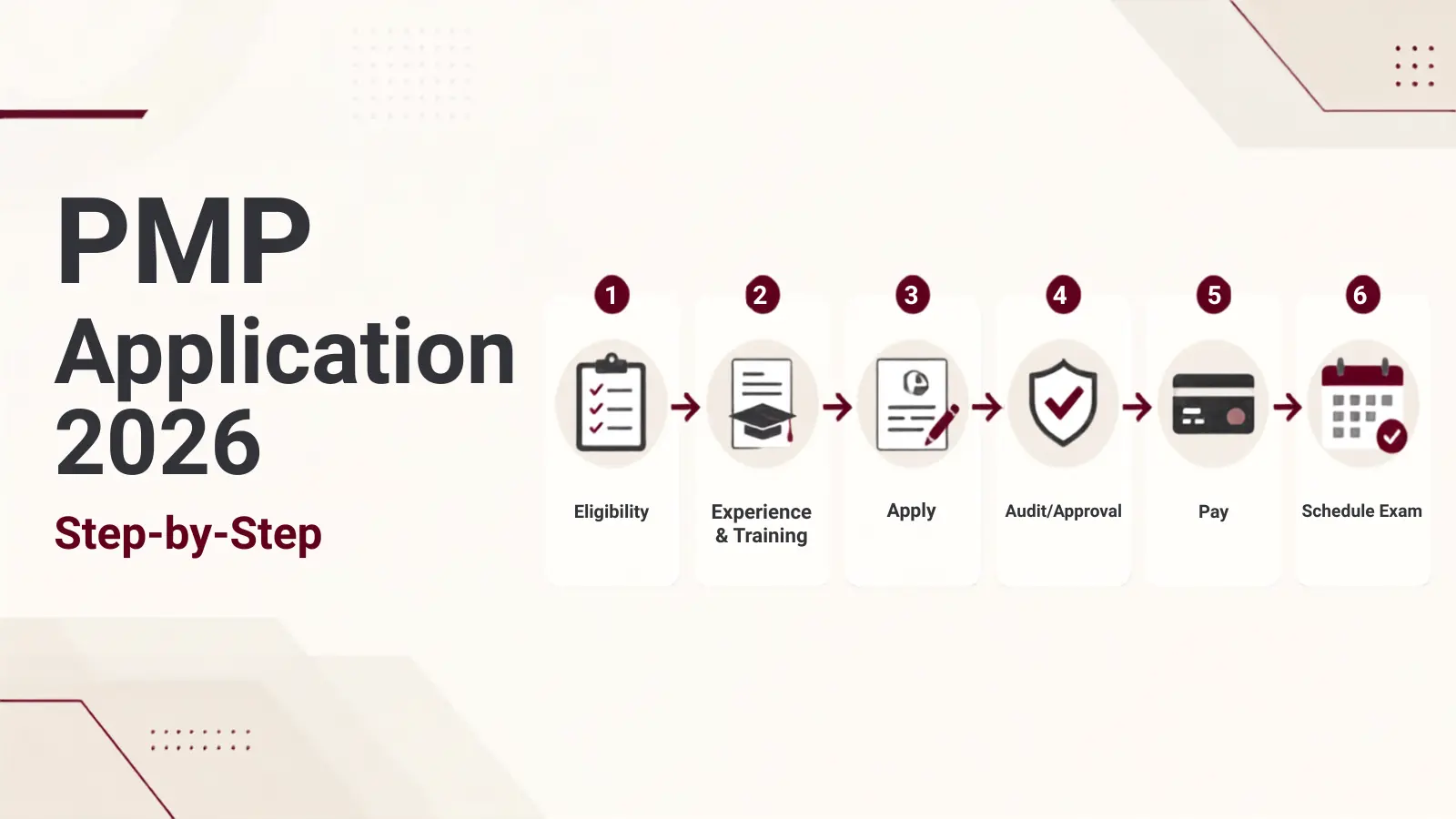
PMP Exam Eligibility Requirements in 2026
Find out whether you qualify for the PMP exam in 2026, including the four education and experience pathways, the 10-year experience window, 35 training hours, CAPM rules, and what PMI counts as project experience.
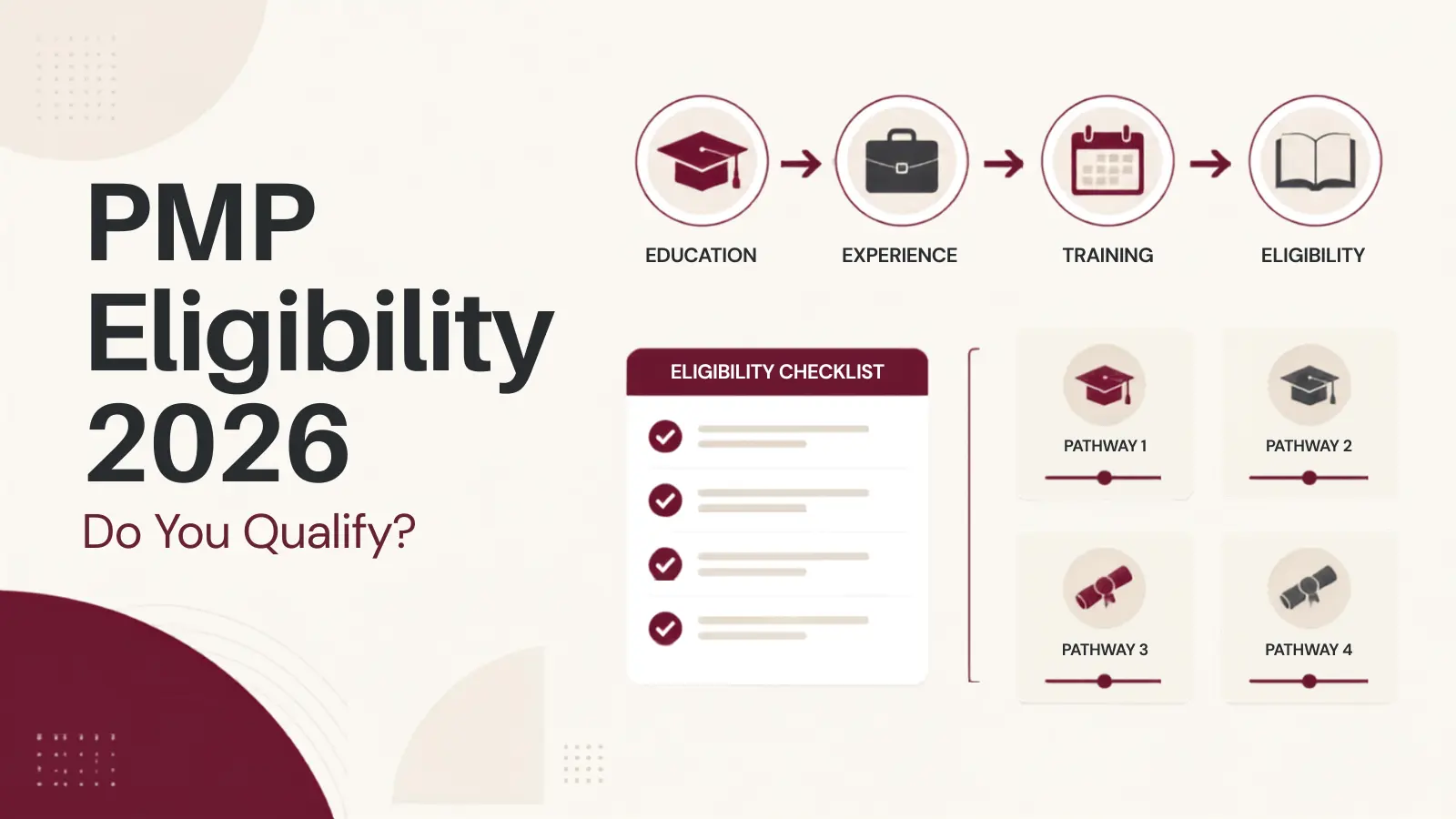
To qualify for the Project Management Professional (PMP)® certification in 2026, you need the right combination of education, professional project experience, and project management training.
The requirements are not the same for every candidate. The amount of experience you need depends on your educational background, and PMI now recognizes four main eligibility pathways.
The good news is that you do not need to have held the job title "Project Manager." What matters is whether your professional experience shows that you actually led and directed project work.
This guide explains the current PMP eligibility requirements, what counts as project experience, how overlapping projects are treated, the 35-hour training requirement, and the important training-rule change taking effect on December 1, 2026.
Quick answer: Depending on your education, you need between 24 and 60 months of non-overlapping project leadership experience earned within the last 10 years, plus 35 hours of qualifying project management training or an active CAPM certification.
For the broader changes introduced with the current exam, see our guide to the PMP exam changes in 2026.
PMP eligibility requirements for 2026
PMI currently provides four education and experience pathways.
You need to satisfy one of them.
| Educational background | Professional project experience required |
|---|---|
| High school diploma, GED, secondary or upper-secondary school certificate, or equivalent | 60 months / 5 years |
| Associate-level degree, qualifying technical/vocational program, or equivalent | 48 months / 4 years |
| Bachelor's degree or higher, or qualifying bachelor-equivalent credential | 36 months / 3 years |
| Bachelor's or postgraduate degree from a PMI GAC-accredited program | 24 months / 2 years |
In every pathway, the qualifying project experience must be:
- professional;
- based on leading and directing project work;
- non-overlapping when months are counted;
- earned within the 10 years before you submit your application.
You also need to satisfy PMI's project management training requirement.
PMI's current PMP eligibility requirements should always be your final reference before submitting an application.
Path 1: Secondary education plus 5 years of experience
If your highest qualifying education is a high school diploma, GED, secondary or upper-secondary school certificate, or equivalent, you need at least:
60 months, or 5 years, of non-overlapping professional experience leading projects.
Those months must fall within the 10-year eligibility window.
This does not mean you need to have spent five years with the formal title of Project Manager.
A candidate may qualify through other roles if the actual work involved leading and directing projects.
Path 2: Associate-level or qualifying technical education plus 4 years
The 2026 requirements include a separate pathway for candidates with certain post-secondary, associate-level, technical, vocational, or equivalent qualifications.
This pathway requires:
48 months, or 4 years, of non-overlapping professional project experience.
This is an important change for candidates whose education falls between secondary-school completion and a bachelor's degree.
Because educational systems differ significantly between countries, candidates with technical or vocational qualifications should verify how their credential maps to PMI's current eligibility framework before applying.
Path 3: Bachelor's degree or higher plus 3 years
If you hold a recognized bachelor's degree or higher, the standard experience requirement is:
36 months, or 3 years, of non-overlapping professional experience leading projects.
This is one of the most common PMP eligibility pathways.
A master's degree does not normally reduce the experience requirement below 36 months simply because it is a higher degree. The separate 24-month pathway applies specifically to qualifying degrees from programs accredited by PMI's Global Accreditation Center.
Path 4: GAC-accredited degree plus 2 years
Candidates with a bachelor's or postgraduate degree awarded by a program accredited by the PMI Global Accreditation Center for Project Management Education Programs (GAC) can qualify with:
24 months, or 2 years, of non-overlapping professional project experience.
The important distinction is the accreditation of the academic program, not simply the fact that your university offers project management courses.
If you are unsure whether your program is GAC-accredited, verify it through PMI rather than assuming that a project management degree automatically qualifies for this pathway.
The experience window is now 10 years
One of the important 2026 eligibility changes is the expansion of the experience look-back period.
Your qualifying project experience must have been earned within the 10 years immediately before your PMP application is submitted.
For example, if you submit your application in September 2026, qualifying experience can generally come from professional project work performed during the preceding 10-year period.
This gives some experienced candidates more flexibility than the previous eligibility framework.
PMI highlights the expanded 10-year experience window as one of the changes introduced with the updated 2026 PMP certification requirements.
What counts as PMP project management experience?
This is where many candidates become uncertain.
PMI is looking for professional experience leading and directing projects.
According to PMI, qualifying experience does not necessarily have to be paid, but it must occur in a professional setting.
Examples may include:
- leading a software or system implementation;
- coordinating a product or service launch;
- leading a cross-functional improvement initiative;
- managing a regulatory or compliance project;
- coordinating a customer delivery project;
- leading a workstream within a larger program;
- managing scope, schedule, resources, risks, issues, communications, or stakeholders for a defined project;
- directing planning, delivery, transition, or project outcomes.
The exact industry does not matter.
Projects can exist in IT, construction, banking, engineering, healthcare, manufacturing, public services, consulting, telecommunications, transportation, marketing, and many other fields.
What matters is the nature of the work.
Do you need the job title "Project Manager"?
No.
PMI's current application guidance makes clear that the job title itself is less important than the work you performed.
Someone with a title such as:
- Project Coordinator;
- Business Analyst;
- Implementation Manager;
- Team Lead;
- PMO Analyst;
- Engineer;
- Consultant;
- Product Lead;
- Operations Lead;
may have qualifying experience if they genuinely led and directed project work.
Likewise, simply having "Project Manager" in your job title does not automatically make all of your work eligible.
Your experience must still relate to projects rather than routine operations.
PMI's guidance on what counts as project management experience provides useful examples for candidates who are unsure how their role fits.
What does not count as PMP experience?
Not every activity that requires planning or coordination qualifies as professional project management experience.
PMI specifically distinguishes professional project work from activities such as:
- school projects;
- academic research performed for a degree program;
- planning personal events;
- home improvement projects;
- routine operational work;
- routine administrative work.
The difference is important.
For example, handling the same operational process every week is generally not a project.
Leading a temporary initiative to redesign that process, coordinate stakeholders, manage a schedule, implement the change, and deliver a defined outcome may be project work.
A project has a temporary nature, a defined objective or outcome, and a unique context.
Your experience is counted in months, not number of projects
PMI measures PMP experience in months.
Completing more projects does not automatically give you more qualifying months.
This becomes especially important when projects overlap.
Suppose you led:
- Project A from January through June;
- Project B from March through August.
You cannot claim six months for Project A plus another six months for Project B and call that 12 months of experience.
The overlapping period only counts once.
Your total elapsed professional project experience in that example is January through August: 8 months.
PMI requires candidates to avoid double-counting overlapping project periods.
Do agile and hybrid projects count?
Yes.
PMP eligibility is not limited to traditional predictive projects.
Professional experience leading projects may come from predictive, agile, adaptive, or hybrid environments.
What matters is whether the work qualifies as professional project experience and whether you were genuinely involved in leading and directing it.
This aligns with the current PMP exam itself, which evaluates project professionals across predictive, adaptive/agile, and hybrid ways of working.
You can learn more about the current exam structure in our PMP 2026 exam guide.
Do you need experience in every PMP domain?
You should not interpret the eligibility requirement as meaning that every project must independently demonstrate every possible project management task.
PMI wants evidence of genuine professional experience leading and directing projects.
Your application should accurately describe the project, your responsibilities, the work you led, and the outcome.
Do not artificially insert terminology merely to make an application sound more "PMP-like."
Clear, truthful descriptions are more important than keyword stuffing.
The 35-hour project management training requirement
Professional experience alone is not enough.
PMP candidates also need 35 hours of qualifying project management training.
The training should cover project-management-related learning aligned with the PMP Examination Content Outline.
Examples of relevant areas can include:
- project scope;
- schedule;
- risk;
- stakeholder engagement;
- communications;
- procurement;
- financial management;
- resources;
- governance;
- integration and delivery.
The 35 hours must be completed before the relevant certification requirements are satisfied.
Practice questions and books by themselves do not constitute the required training.
Does CAPM satisfy the 35-hour PMP training requirement?
Under PMI's current published PMP requirements, an active CAPM® certification fulfills the PMP training requirement.
You still need to satisfy the PMP education and professional experience requirements.
CAPM does not replace the required project experience.
For candidates who do not yet have enough experience for PMP, CAPM can therefore be a useful earlier certification while they continue building professional project leadership experience.
Important: PMP training rules change on December 1, 2026
Candidates preparing during 2026 need to pay attention to one additional rule change.
For training completed before December 1, 2026, PMI states that the current training-provider requirements continue to apply.
Starting December 1, 2026, live instructor-led training used toward PMP eligibility must be delivered by an eligible provider, including:
- a PMI Authorized Training Partner;
- a China Registered Education Provider;
- an eligible accredited higher-education program, including qualifying GAC programs.
The restriction applies to live instructor-led training, whether delivered in person or virtually.
PMI currently states that self-paced training can still come from other organizations.
If you plan to purchase a live PMP course late in 2026, verify the provider's eligibility before enrolling.
Do training hours expire?
PMI's current Examination Content Outline indicates that candidates should record qualifying training hours and complete the required coursework as part of the certification process.
Because provider eligibility rules are changing in December 2026, the safest approach is to retain clear documentation showing:
- course name;
- provider;
- completion date;
- number of qualifying hours;
- certificate or completion record.
Always check PMI's current requirements when you are ready to apply.
What happens if PMI audits your application?
PMI can select applications for audit.
If that happens, you may need to provide documentation supporting your education, training, and professional experience.
The possibility of an audit is another reason to make your application completely accurate.
Before applying, make sure you can substantiate:
- your educational credential;
- your qualifying training;
- the projects you list;
- your role and responsibilities;
- the dates of your experience.
Do not exaggerate dates, responsibilities, or project leadership.
An accurate application is easier to support if verification is requested.
A simple PMP eligibility checklist
Before starting your application, check these five points.
1. Identify your education pathway
Determine whether you fall under the:
- secondary education pathway;
- associate/technical pathway;
- bachelor's-or-higher pathway;
- GAC-accredited degree pathway.
2. Calculate your non-overlapping experience
Map your qualifying projects by month.
Remove overlapping months from the total.
3. Check the 10-year window
Confirm that the experience you intend to claim falls within the 10 years before your application.
4. Confirm your 35 training hours
Make sure your training meets the current PMI requirements, or confirm that your active CAPM satisfies the training requirement.
5. Gather evidence before applying
Keep your education, training, project dates, roles, and supporting information organized in case PMI asks you to verify them.
PMP eligibility examples
Here are several simplified examples.
Example 1: Bachelor's degree with 40 months of experience
You hold a recognized bachelor's degree and have accumulated 40 non-overlapping months leading projects during the past 10 years.
You meet the 36-month experience threshold.
If you also satisfy the training requirement, you may be eligible to apply.
Example 2: Secondary school diploma with 48 months of experience
You have a high school or secondary school diploma and four years of qualifying project experience.
You do not yet meet the 60-month requirement for that pathway.
You would need additional qualifying experience before applying.
Example 3: Associate-level qualification with 50 months of experience
You hold a recognized qualification that falls within PMI's associate/technical pathway and have 50 non-overlapping months of qualifying project experience.
You meet the 48-month experience requirement, subject to the remaining eligibility conditions.
Example 4: Two overlapping projects
You led Project A for eight months and Project B for six months, but four months overlapped.
You cannot claim 14 months.
The overlapping period is counted once, so the total qualifying duration would be 10 months.
What if you are not eligible yet?
If you do not currently meet the PMP requirements, that does not mean you should abandon the goal.
First determine exactly what is missing.
If the gap is experience, continue building professional project leadership responsibilities and keep records of the projects you lead.
If the gap is training, complete qualifying project management education.
If you are earlier in your project management career, consider whether the CAPM certification is more appropriate while you gain the experience required for PMP.
You can also explore the CertOnyx PMP preparation area once you are ready to begin preparing for the exam itself.
Frequently asked questions about PMP eligibility
Can I apply for PMP without being a Project Manager?
Yes. Your job title does not determine eligibility. Your professional responsibilities and actual experience leading and directing project work are what matter.
Is PMP experience required to be paid?
Not necessarily. PMI states that the experience does not have to be paid, but it must take place in a professional setting.
Can I count university projects?
Academic projects completed as part of a degree program do not qualify as professional PMP project experience.
Can I count two projects that happened at the same time?
You can list both, but you cannot double-count the overlapping months toward your experience total.
How recent must my PMP experience be?
Qualifying experience must fall within the 10 years before your application submission.
How many years of experience do I need for PMP in 2026?
Depending on your educational pathway, you need:
- 5 years with secondary education;
- 4 years with an eligible associate/technical qualification;
- 3 years with a bachelor's degree or higher;
- 2 years with a qualifying GAC-accredited degree.
Are 35 hours of training still required?
Yes. PMI currently requires 35 hours of qualifying project management training, with an active CAPM certification also satisfying the training requirement.
The key takeaway
PMP eligibility in 2026 is based on three things:
your education, your professional project leadership experience, and your project management training.
The most important changes candidates should understand are the four current education pathways and the expanded 10-year experience window.
Do not focus only on whether your job title says "Project Manager."
Instead, examine the work you have actually done.
If you have led temporary professional initiatives, taken responsibility for planning and decisions, coordinated stakeholders and delivery, managed project challenges, and helped produce defined outcomes, some of that experience may qualify.
Map your projects carefully, avoid double-counting overlapping months, verify your education pathway, confirm your training, and compare everything against PMI's current requirements before submitting your application.
Official sources
This guide is based on current information published by the Project Management Institute:
- PMI: PMP certification and current eligibility requirements
- PMI: PMP Examination Content Outline 2026
- PMI: How to Apply for the PMP — What Counts as Project Management Experience
- PMI: 2026 PMP exam and training requirement updates
Eligibility rules can change. Check PMI's official website before submitting your PMP application.
CertOnyx is an independent exam-preparation platform and is not affiliated with, endorsed by, or sponsored by the Project Management Institute.