8-Week PMP Study Plan 2026: Week-by-Week Schedule
Follow an 8-week PMP study plan for 2026 with weekly goals for the ECO, People, Process, Business Environment, practice questions, mock exams, and final review.
8-Week PMP Study Plan 2026: Week-by-Week Schedule
Preparing for the PMP exam can feel overwhelming when your study materials include the Examination Content Outline, PMBOK guidance, predictive project management, agile and hybrid approaches, formulas, scenario questions and full mock exams.
The solution is not to study everything at once.
A structured 8-week PMP study plan gives each part of your preparation a purpose and gradually shifts your focus from learning concepts to applying them under exam conditions.
This plan is designed for candidates preparing for the 2026 PMP exam and follows the current July 2026 Examination Content Outline.
It combines:
- the three PMP domains;
- predictive, agile and hybrid approaches;
- scenario-based practice;
- error analysis;
- timed question sets;
- mock exams;
- targeted final revision.
Quick answer: Over eight weeks, begin by understanding the exam and establishing your baseline, then cover People, Process and Business Environment, integrate predictive/agile/hybrid reasoning, increase scenario practice, complete full mock exams, and use the final week for targeted review rather than learning large amounts of new material.
This is a practical CertOnyx study framework, not an official PMI-required schedule. If eight weeks does not fit your available time, extend or compress the plan while preserving the same progression.
Is 8 weeks enough to study for the PMP exam?
For many candidates, eight weeks can provide enough structure to prepare seriously for PMP, but there is no universal study duration.
Your starting point matters.
You may need more time if:
- project management is relatively new to you;
- your experience is concentrated in only one delivery approach;
- agile or hybrid concepts are unfamiliar;
- you have limited weekly study time;
- your initial diagnostic score reveals major gaps.
You may move faster if you already work with many of the concepts tested on the exam and can dedicate consistent time each week.
The goal is not to finish in exactly eight weeks.
The goal is to arrive at the exam able to apply project-management reasoning consistently across the current PMP blueprint.
For the broader learning method behind this schedule, first read our guide on how to study for the PMP exam in 2026.
Before you start: know the 2026 PMP exam
Your study schedule should reflect the exam you will actually take.
The current PMP exam contains:
- 180 questions
- 170 scored questions
- 10 unscored pretest questions
- 240 minutes
- two 10-minute breaks
The current domain weights are:
| PMP domain | Weight |
|---|---|
| People | 33% |
| Process | 41% |
| Business Environment | 26% |
PMI also states that approximately 40% of exam items represent predictive approaches, while the remaining approximately 60% is divided between adaptive/agile and hybrid approaches.
That means your eight-week plan must cover more than traditional predictive project management.
Predictive, agile and hybrid reasoning should appear throughout your preparation.
For the detailed structure of the examination, see our PMP Exam Format 2026 guide.
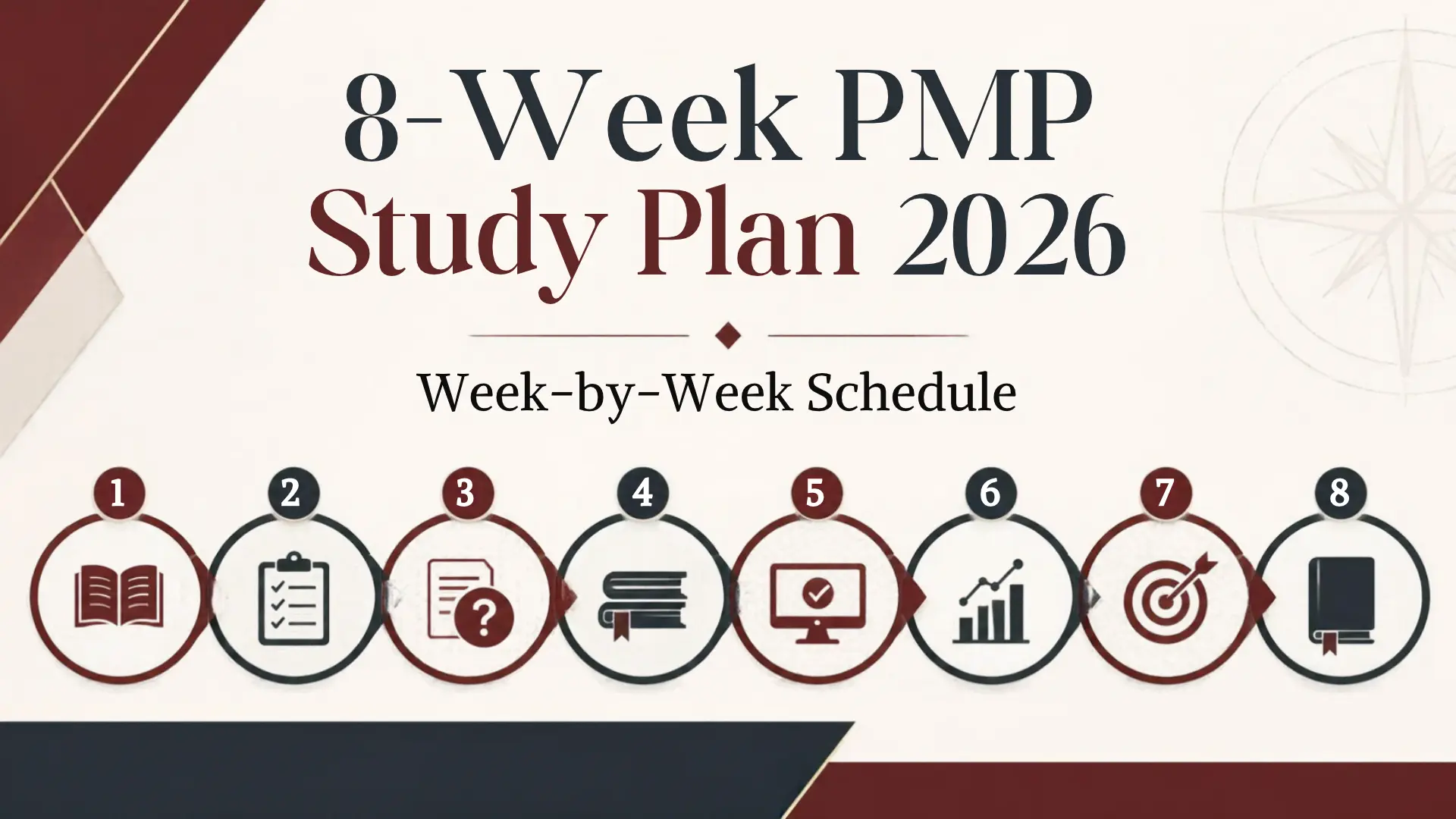
The 8-week PMP study plan at a glance
| Week | Main focus | Primary objective |
|---|---|---|
| Week 1 | Exam blueprint and baseline | Understand the exam and identify gaps |
| Week 2 | People domain | Strengthen leadership, stakeholders and communication |
| Week 3 | Process domain — Part 1 | Planning, scope, value, resources and procurement |
| Week 4 | Process domain — Part 2 | Finance, quality, schedule, status and closure |
| Week 5 | Business Environment | Governance, compliance, change, risk and external environment |
| Week 6 | Integrated scenario practice | Predictive, agile and hybrid decision-making |
| Week 7 | Mock exam and weak areas | Test endurance and repair weaknesses |
| Week 8 | Final review and exam readiness | Consolidate, simulate and taper |
A useful principle across all eight weeks is:
Learn → Practice → Review → Correct → Repeat
Do not spend six weeks reading and only begin practice questions at the end.
Practice should start in Week 1 and increase progressively.
Week 1: Understand the exam and establish your baseline
The goal of Week 1 is not to master the entire PMP syllabus.
It is to understand the map.
Study the current PMP Examination Content Outline
Begin with the July 2026 PMP Examination Content Outline.
Understand the hierarchy:
Domain → Task → Enabler
The current ECO contains:
- 3 domains;
- 26 tasks;
- 138 listed enablers.
Use the ECO as your coverage map rather than a document to memorize line by line.
Our PMP Exam Content Outline 2026 guide explains this structure in detail.
Take an initial diagnostic
Complete a mixed set of PMP-style questions before you have studied everything.
The purpose is not to earn an impressive score.
It is to identify:
- familiar topics;
- weak domains;
- terminology gaps;
- difficulty with agile or predictive scenarios;
- question-reading problems.
Record the results by topic if possible.
Create your error log
From the first week onward, keep a simple error log.
For each important mistake, record:
| Area | What went wrong | What to remember |
|---|---|---|
| Risk | Treated future uncertainty as current issue | Confirm whether event has occurred |
| Stakeholder | Escalated too early | Analyze and engage first when appropriate |
| Change | Implemented before approval | Follow applicable governance/change process |
The error log will become more valuable than rereading hundreds of pages.
Week 1 target
By the end of Week 1, you should:
- understand the exam format;
- know the three domains and weights;
- understand the ECO structure;
- have a baseline practice result;
- have identified several initial weak areas;
- have started an error log.
Do not worry if your first score is low.
It is a baseline, not a prediction of your final result.
Week 2: Master the People domain
People represents 33% of the current exam.
This week should focus on project leadership and human interaction.
Important areas include:
- common vision;
- conflict management;
- team leadership;
- stakeholder engagement;
- stakeholder expectations;
- knowledge transfer;
- communication.
Study conflict as a decision process
Do not memorize one "best" conflict technique for every situation.
Practice identifying:
- the source of the conflict;
- who is involved;
- the context;
- whether intervention is needed;
- which response is appropriate.
Strengthen stakeholder reasoning
PMP scenarios frequently involve stakeholders.
Practice distinguishing between:
- identifying a stakeholder;
- analyzing influence or expectations;
- planning engagement;
- communicating;
- aligning expectations;
- monitoring satisfaction.
These activities are related but not identical.
Practice leadership questions
When reviewing leadership scenarios, ask:
- Does the team need direction or empowerment?
- Is this a performance problem or a communication problem?
- Does the project manager have enough information to act?
- Is escalation necessary yet?
- Can the issue be resolved collaboratively?
Avoid simplistic rules such as "never escalate."
Week 2 practice
Combine topic review with scenario questions every study session.
Do not merely record whether an answer was right or wrong.
Explain why the correct answer is stronger than the distractors.
Week 2 target
By the end of Week 2, you should be more comfortable with:
- team leadership;
- conflict;
- stakeholder analysis;
- communication;
- expectation management;
- collaborative problem solving.
Week 3: Process domain — planning, scope, value, resources and procurement
Process is the largest PMP domain at 41%, so this plan gives it two dedicated weeks.
Week 3 focuses on the first half.
Integrated planning
Understand how project components interact.
Do not study scope, schedule, resources and risk as though they operate independently.
A change in one area can affect several others.
Practice identifying dependencies and downstream impacts.
Scope
Study how scope is:
- defined;
- agreed;
- broken down;
- managed according to the delivery approach.
Pay attention to the difference between controlled change and normal backlog evolution in adaptive environments.
Value-based delivery
One of the most important PMP mindsets is that project success is not simply completing activities.
Candidates should understand:
- value;
- outcomes;
- prioritization;
- incremental delivery;
- benefits.
Ask repeatedly:
What creates the most useful outcome for the customer or organization?
Resources
Study both planning and optimization.
Resource questions can involve:
- availability;
- skills;
- constraints;
- competing demand;
- team needs.
Procurement
Cover:
- procurement planning;
- contract considerations;
- vendor performance;
- negotiations;
- supplier management.
Avoid memorizing oversimplified statements about which contract type is always best.
The project context determines the decision.
Week 3 target
By the end of the week, you should understand how planning, scope, value, resources and procurement interact rather than viewing them as isolated chapters.
Week 4: Process domain — finance, quality, schedule, status and closure
Continue the Process domain with areas that often require both conceptual and quantitative reasoning.
Finance
Review:
- project financial needs;
- financial tracking;
- contingency considerations;
- financial variation;
- reserves.
If formulas appear in your preparation, understand the meaning behind them rather than memorizing symbols only.
For example:
CPI = EV / AC
Knowing the formula matters.
Understanding what a CPI below 1.0 means is more important.
Quality
Study quality throughout the project rather than treating it only as inspection at the end.
Review:
- quality requirements;
- prevention;
- reviews;
- cost of quality;
- continuous improvement.
Schedule
Understand:
- dependencies;
- milestones;
- estimation;
- baselines where applicable;
- schedule variance;
- adaptation to different delivery approaches.
Later in this series, we will cover Critical Path Method in a dedicated guide.
Project status
Practice interpreting:
- metrics;
- artifacts;
- status information;
- trends;
- variance.
Do not focus only on producing reports.
Think about how information supports decisions.
Closure
Review:
- acceptance;
- completion criteria;
- transition readiness;
- lessons learned;
- resource and contract closure;
- final documentation.
Do not assume closure disappears in agile environments.
Week 4 target
By the end of Week 4, you should have covered the major Process competencies and should be increasing the proportion of mixed rather than topic-isolated questions.
Week 5: Business Environment
Business Environment accounts for 26% of the 2026 PMP exam.
It should not be treated as a minor final chapter.
Important areas include:
- governance;
- compliance;
- change;
- impediments and issues;
- risk;
- continuous improvement;
- organizational change;
- external business environment.
Governance
Learn to distinguish:
Project management
from:
Project governance
Governance establishes decision structures, policies, authority, escalation paths and oversight.
Questions may test whether an action belongs to the project manager or another governance body.
Compliance
Review how projects identify and respond to requirements involving areas such as:
- regulation;
- security;
- health and safety;
- sustainability;
- organizational policy.
Compliance is not simply something checked at project closure.
Change
Study the difference between:
- identifying a possible change;
- assessing the change;
- approving or rejecting it;
- implementing an approved change;
- updating relevant information.
The exact process can depend on the project environment.
Risks, issues and impediments
Make sure you can distinguish these quickly.
A risk concerns uncertainty.
An issue is already occurring or has occurred.
An impediment obstructs progress.
The appropriate response depends on which situation actually exists.
Organizational and external change
Projects are affected by their environment.
Practice scenarios involving:
- new regulations;
- technology changes;
- market shifts;
- organizational restructuring;
- changes in business priorities.
Week 5 target
By the end of Week 5, you should be able to identify Business Environment questions quickly and connect them to governance, risk, compliance and organizational context.
Week 6: Integrate predictive, agile and hybrid reasoning
Week 6 is where preparation should become much more scenario-driven.
You have now covered the major domains.
The next step is integration.
Stop studying approaches as separate worlds
PMI states that predictive, adaptive/agile and hybrid approaches can appear throughout the exam.
Practice identifying the project environment from clues.
Predictive clues may include:
- detailed upfront planning;
- baselines;
- formal change control;
- defined scope;
- sequential delivery.
Agile/adaptive clues may include:
- evolving backlog;
- frequent feedback;
- iterative delivery;
- reprioritization;
- self-managing teams.
Hybrid clues may include:
- iterative product development with formal governance;
- predictive milestones combined with adaptive delivery;
- different approaches used in different parts of the project.
Increase mixed scenario practice
This week, reduce isolated topic quizzes.
Use mixed sets that force you to identify:
- the domain;
- the problem;
- the delivery approach;
- what has already happened;
- the best next action.
Practice question sequencing
Pay special attention to wording such as:
- first;
- next;
- best;
- should do;
- should have done.
Often several answers are reasonable actions.
Only one is appropriate at that specific point.
Review your error log
By Week 6, patterns should be emerging.
Look for recurring mistakes such as:
- escalating too quickly;
- acting before analyzing;
- confusing risk and issue;
- ignoring governance;
- missing agile clues;
- applying predictive controls to adaptive scenarios;
- selecting a reasonable action in the wrong sequence.
These patterns should determine what you revise.
Week 6 target
Your goal is no longer simply:
Do I know this topic?
It becomes:
Can I apply this topic correctly when the exam mixes it with other information?
Week 7: Full mock exam and targeted repair
Week 7 shifts your preparation toward exam conditions.
Take a full-length mock exam
At this point, a full simulation becomes valuable.
The real PMP exam contains 180 questions in 240 minutes, so endurance and pacing matter.
During the simulation:
- use realistic timing;
- minimize interruptions;
- practice your planned break strategy;
- avoid checking explanations during the exam.
The score is useful, but the review is more important.
Analyze the mock deeply
After the mock, classify mistakes.
Do not simply review incorrect answers.
Also review questions where:
- you guessed;
- you were uncertain;
- you changed from correct to incorrect;
- you took too much time;
- you arrived at the correct answer for the wrong reason.
Group weaknesses by:
- domain;
- topic;
- delivery approach;
- reasoning pattern.
Build a repair list
Create a short list such as:
- governance authority;
- financial reserves;
- agile stakeholder communication;
- procurement risk;
- change-control sequencing.
Spend the remainder of Week 7 repairing those specific weaknesses.
Do not restart your entire PMP course because of one disappointing mock result.
Week 7 target
By the end of Week 7, you should know exactly where your remaining weaknesses are.
Week 8: Final review and exam readiness
The last week is for consolidation.
It is not the best time to introduce several completely new books, courses or question banks.
Take your final major simulation early in the week
If you want another full mock, take it early enough to allow time for review.
Do not schedule an exhausting full simulation immediately before your actual exam.
Review your highest-value notes
Focus on:
- error log;
- repeated weak topics;
- formulas and interpretation;
- governance;
- risk vs issue;
- change;
- stakeholder reasoning;
- agile/predictive/hybrid distinctions;
- exam pacing.
Use shorter mixed sets
Shorter question sets can keep your reasoning active without creating unnecessary fatigue.
The objective is confidence and consistency.
Review exam logistics
Make sure you know:
- your exam date and time;
- test-center or online requirements;
- identification requirements;
- check-in expectations;
- break rules.
If you have not yet completed the administrative process, review our step-by-step PMP application guide.
Reduce intensity near exam day
The final day should not become a desperate attempt to learn the entire syllabus again.
Light review is usually more useful than exhausting yourself.
Your preparation over the previous weeks matters much more than one final marathon session.
Week 8 target
Arrive at exam day with:
- a clear pacing strategy;
- familiarity with full-length question sessions;
- a reviewed error log;
- no major unaddressed domain;
- confidence interpreting predictive, agile and hybrid scenarios.
A practical weekly PMP study schedule
The exact number of hours depends on your availability.
An example weekly rhythm could be:
Monday
Learn or review the week's main concepts.
Tuesday
Continue concept review and create short notes.
Wednesday
Answer topic-based practice questions.
Thursday
Review errors and revisit weak concepts.
Friday
Complete a mixed question set.
Weekend
Use one longer study session for:
- cumulative review;
- mixed practice;
- error-log analysis;
- mock exams during later weeks.
This schedule is only an example.
PMI does not prescribe a required number of study hours.
Consistency matters more than forcing yourself into someone else's timetable.
How many practice questions should you do during the 8 weeks?
There is no official number of questions that guarantees PMP success.
Question quality and review quality matter more than accumulating a large total.
Early in the plan, use smaller topic-focused sets.
As your knowledge develops, increase:
- mixed-domain questions;
- scenario questions;
- timed sets;
- full simulations.
If you answer a question incorrectly, the most important step is understanding why.
If you answer correctly but guessed, review it too.
A smaller number of carefully reviewed questions can provide more value than rushing through thousands.
What if you fall behind the 8-week plan?
Do not try to compensate by skipping entire domains.
Instead, adjust the schedule.
For example:
If Week 3 takes longer than expected, move the remaining work forward and extend your exam date if necessary.
Protect these parts of the plan:
- complete domain coverage;
- mixed scenario practice;
- mistake analysis;
- at least one realistic full simulation;
- targeted final review.
The calendar is flexible.
Coverage and understanding are more important than staying perfectly aligned to a date.
Can you compress this PMP plan into 4 or 6 weeks?
Yes, if your background and available study time allow it.
But compress the calendar — not the reasoning process.
You still need to:
- understand the ECO;
- cover all three domains;
- practice predictive, agile and hybrid scenarios;
- analyze mistakes;
- complete timed practice;
- identify weak areas.
A shorter schedule generally means more study time per week.
Do not remove essential exam areas simply to meet an arbitrary deadline.
Can you extend the plan to 10 or 12 weeks?
Yes.
If you have limited weekly availability, extending the plan can be better than trying to fit unrealistic study sessions into eight weeks.
You can use the additional weeks to:
- reduce daily workload;
- add spaced review;
- increase targeted practice;
- revisit weak topics;
- add an additional mock simulation.
The eight-week structure is a framework, not a requirement.
When should you schedule the PMP exam?
Ideally, your exam date should create enough urgency to keep your preparation focused without forcing you to sit before you are ready.
Before scheduling, make sure you understand the current PMP eligibility requirements for 2026.
If you are still completing the application process, use our guide on how to apply for the PMP exam in 2026.
Signs that your 8-week PMP plan is working
Your preparation should gradually become more efficient.
Positive signs include:
- fewer repeated reasoning mistakes;
- better performance across all three domains;
- faster recognition of the real problem in a scenario;
- stronger distinction between risk, issue, change and impediment;
- better recognition of predictive, agile and hybrid context;
- improved pacing;
- more consistent mixed-question scores;
- less dependence on memorized answer rules.
The objective is not perfection.
It is reliable project-management reasoning under exam conditions.
Frequently asked questions about the 8-week PMP study plan
Is 8 weeks enough to pass the PMP exam?
Eight weeks can be a practical preparation period for many candidates, but no duration guarantees success.
Your project-management background, available study time and practice performance matter more than the calendar alone.
How many hours per week should I study for PMP?
PMI does not prescribe a required number of weekly study hours.
Choose a schedule you can sustain consistently and increase or decrease it according to your starting level, exam date and practice performance.
Should I study every day?
Not necessarily.
Regular study is useful, but rest and consolidation also matter.
A sustainable schedule is better than intense study for several days followed by long periods of inactivity.
When should I start doing PMP practice questions?
Start early.
You do not need to finish all your reading first.
Practice questions help reveal whether you can apply concepts rather than merely recognize terminology.
When should I take my first full PMP mock exam?
For this eight-week plan, Week 7 is a useful point for a full simulation because you have already covered the major domains.
Candidates with stronger preparation may take one earlier.
How many full PMP mock exams should I take?
There is no official required number.
Use enough simulations to test endurance, pacing and mixed-topic reasoning without replacing targeted learning and review.
Should I memorize the PMP ECO?
No.
Use the ECO as a coverage map.
Understand the responsibilities represented by its domains, tasks and enablers rather than memorizing every sentence.
What should I study during the final week before PMP?
Focus on weak areas, your error log, mixed scenarios, pacing and high-value review.
Avoid trying to learn large amounts of completely new material immediately before the exam.
Final 8-week PMP preparation checklist
Before exam day, confirm that you have:
- reviewed the current PMP Examination Content Outline;
- covered People, Process and Business Environment;
- practiced predictive scenarios;
- practiced agile/adaptive scenarios;
- practiced hybrid scenarios;
- reviewed key formulas and their meaning;
- practiced situational questions;
- analyzed your mistakes;
- completed timed mixed-question sessions;
- completed at least one realistic full simulation;
- reviewed remaining weak areas;
- developed an exam pacing strategy.
The purpose of an 8-week PMP study plan is not to force every candidate into the same calendar.
It is to give your preparation a logical progression:
Understand → Learn → Practice → Integrate → Simulate → Refine
If you want to understand the learning method behind this schedule, read our complete guide on how to study for the PMP exam in 2026.
For the official blueprint behind the study plan, see our PMP Exam Content Outline 2026 guide.
For exam-day structure, timing, breaks and question types, see our PMP Exam Format 2026 guide.
You can also review what changed in the PMP exam for 2026.
When you are ready to practice your PMP decision-making, explore CertOnyx PMP certification prep.
Official source
This study plan uses the current exam structure and content distribution published by PMI:
Project Management Institute — PMP Certification Exam Content Outline, July 2026
The eight-week schedule itself is a CertOnyx preparation framework and is not an official PMI-prescribed study schedule.
Candidates should always verify current exam information directly with PMI before sitting for the examination.