PMP Exam Format 2026: Questions, Time, Breaks & Question Types
Learn the PMP exam format for 2026: 180 questions, 240 minutes, breaks, domain weights, question types, case studies, and what to expect on exam day.
The PMP exam in 2026 contains 180 questions and gives candidates 240 minutes to complete them.
But those two numbers do not tell you everything you need to know about the current Project Management Professional (PMP)® exam.
The exam updated in July 2026 and now includes a broader range of interactive and scenario-based question formats. Candidates may encounter case studies, graphic-based questions, multiple-response items, matching activities, and other formats in addition to traditional multiple-choice questions.
The way breaks are positioned has also changed from what candidates may remember from older PMP preparation materials.
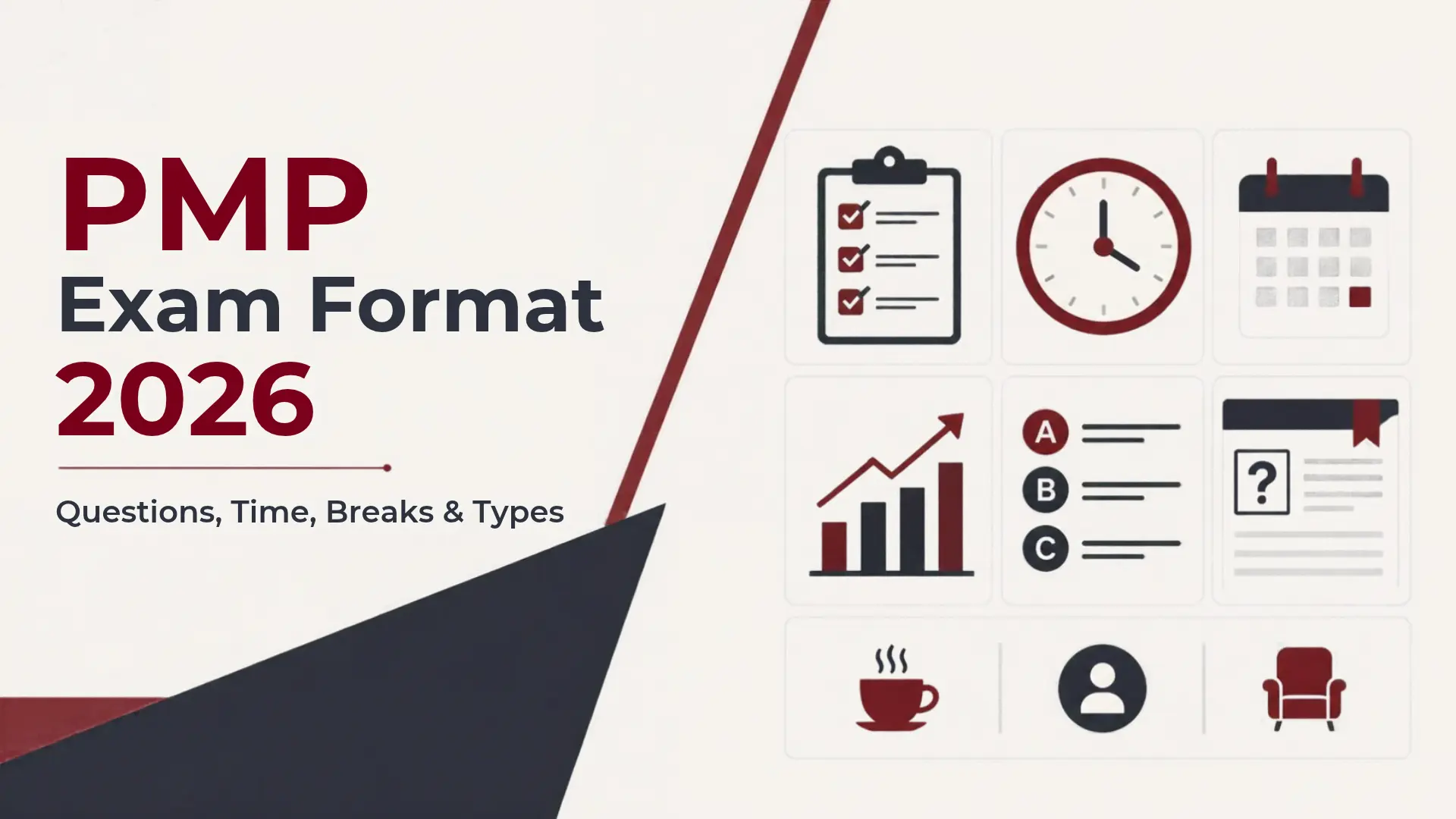
This guide explains the current PMP exam format in 2026, including the number of questions, exam duration, scored and unscored questions, domain weights, question types, breaks, delivery methods, and what the format means for your preparation.
Quick answer: The 2026 PMP exam has 180 questions, of which 170 are scored and 10 are unscored pretest questions. You have 240 minutes to complete the exam. The content is divided across People (33%), Process (41%), and Business Environment (26%), and the exam can include multiple-choice, multiple-response, case/scenario, graphic-based, matching, point-and-click, pull-down, and other interactive formats.
PMP exam format 2026 at a glance
Here are the most important facts about the current exam.
| Exam feature | PMP exam 2026 |
|---|---|
| Total questions | 180 |
| Scored questions | 170 |
| Unscored pretest questions | 10 |
| Exam time | 240 minutes |
| People domain | 33% |
| Process domain | 41% |
| Business Environment domain | 26% |
| Predictive approaches | Approximately 40% |
| Adaptive/agile + hybrid | Approximately 60% combined |
| Scheduled breaks | Two 10-minute breaks |
| Delivery | Test center or online proctored exam |
| Main question experience | Scenario-based, interactive and application-focused |
PMI launched the updated PMP examination on July 9, 2026. If you have been using older study materials, make sure they reflect the current exam rather than the previous version.
For a detailed comparison between the previous and current exam, see our complete guide to the PMP exam changes in 2026.
How many questions are on the PMP exam in 2026?
The PMP exam contains:
- 180 total questions
- 170 scored questions
- 10 unscored pretest questions
The 10 pretest questions are used by PMI to evaluate potential questions for future examinations.
They do not affect your exam score.
However, there is an important catch: you do not know which questions are unscored.
PMI states that the pretest questions are randomly distributed throughout the examination.
You should therefore treat every question as if it counts.
Do not try to identify a question as a pretest item simply because it looks unusually difficult, unfamiliar, or different from the others.
A difficult question may be scored. A straightforward question may be unscored.
There is no useful test-taking strategy based on trying to distinguish between them.
How long is the PMP exam?
You have 240 minutes, or four hours, to answer the 180 questions.
That is a long examination, particularly because many PMP exam questions require more than simple recall.
You may need to:
- read a project scenario;
- identify what has happened;
- distinguish between several reasonable actions;
- interpret a chart or other visual;
- determine what the project manager should do first or next;
- select multiple correct responses;
- analyze information provided in a case study.
Time management therefore matters.
You should not expect every question to require the same amount of time. Some single-response questions may be answered quickly, while a complex scenario or interactive item may require substantially more thought.
A better strategy is to maintain reasonable overall pacing rather than forcing yourself to spend exactly the same amount of time on every question.
Are the PMP exam breaks included in the 240 minutes?
The PMP exam includes two 10-minute breaks.
PMI's 2026 Examination Content Outline states that:
- the first break occurs after the case-study section;
- the second break occurs approximately midway through the independent-question portion of the exam.
There is another important rule. Once you review the questions from a section and begin your break, you cannot return to the questions from the previous section.
That means you should review any marked questions in the section before confirming that you are ready to move on.
Do not assume the old 60-60-60 structure
Older PMP preparation resources often describe the exam as three blocks of 60 questions with breaks after questions 60 and 120.
You should not automatically apply that structure to the July 2026 exam.
PMI's current ECO describes the breaks differently: the first follows the case-study section and the second occurs approximately midway through the independent-question portion. PMI does not state in the current ECO that the first break must occur at question 60 or give a fixed number of questions in the case-study section.
When preparing for the current exam, follow the 2026 structure published by PMI, not a break pattern taken from older PMP resources.
Is the tutorial part of the 240-minute exam time?
No.
PMI states that the exam is preceded by an optional tutorial and followed by an optional survey.
The time used for the tutorial and survey is not included in the 240-minute exam time.
If you are unfamiliar with the testing interface, using the tutorial can be worthwhile. This is especially relevant now that the examination includes several question formats beyond standard multiple choice.
What types of questions are on the PMP exam in 2026?
One of the most important characteristics of the current PMP exam is the variety of question formats. PMI identifies the following types in its 2026 Examination Content Outline.
1. Case or scenario questions
Case or scenario questions are a major part of the updated exam experience.
PMI describes these as detailed situations that may include information such as:
- a business context;
- project circumstances;
- a decision-making situation;
- graphs;
- charts;
- other supporting information.
You review the scenario and then answer a series of questions based on the information provided.
This is different from a normal standalone situational question. Several questions can refer to the same underlying case.
The key skill is therefore not simply remembering facts. You need to identify which information from the case is relevant to each individual question.
Case/scenario questions are available across PMI's exam delivery modalities.
2. Multiple-choice single-response questions
This is the familiar format. You receive several answer choices and select one correct answer.
But do not assume that traditional multiple-choice means easy. PMP exam questions frequently present several actions that could all appear professionally reasonable.
The challenge is determining which response is best for the specific situation described. That often depends on sequence, authority, project approach, stakeholder impact, governance, risk, or the information currently available.
3. Multiple-response questions
Multiple-response questions require you to select more than one correct answer.
Read the instructions carefully. Do not stop after identifying one strong answer. Each option should be evaluated independently against the situation and the question being asked.
This type of question can be particularly challenging because several options may contain good project-management practices, but only the required combination correctly addresses the scenario.
4. Enhanced matching questions
Enhanced matching questions may involve images or diagrams and can include drag-and-drop interaction.
For example, you may need to move items into the correct position or match information to the appropriate category.
PMI marks enhanced matching as available only through computer-based testing (CBT).
5. Graphic-based questions
Graphic-based questions require you to interpret visual information. That could include graphs, charts, diagrams, images, and other visual representations.
You then answer a question based on the information shown.
Do not treat a chart merely as decoration. The visual may contain information necessary to answer the question.
PMI identifies graphic-based questions as available across exam modalities.
6. Point-and-click questions
Point-and-click items present an image containing selectable areas. You respond by clicking the appropriate location or locations on the image.
PMI identifies this format as CBT-only.
These questions test whether you can apply knowledge to information presented visually rather than simply choosing from written options.
7. Matching questions
Matching questions ask you to connect information from different lists or columns. You may need to drag one item to its appropriate corresponding item or category.
PMI also identifies this format as CBT-only.
8. Pull-down list questions
A pull-down question requires you to select the appropriate answer from a drop-down menu.
PMI lists this format as CBT-only.
Does every PMP exam contain the same number of each question type?
No fixed distribution is published.
PMI explicitly notes that the exact number of items for each question type and project-management approach can vary by exam form.
That means you should not build your preparation around assumptions such as an exact number of multiple-response questions, drag-and-drop questions, case-study questions, or agile questions.
Prepare for the formats and competencies PMI publishes rather than trying to predict an exact question count.
What are the PMP exam domain weights in 2026?
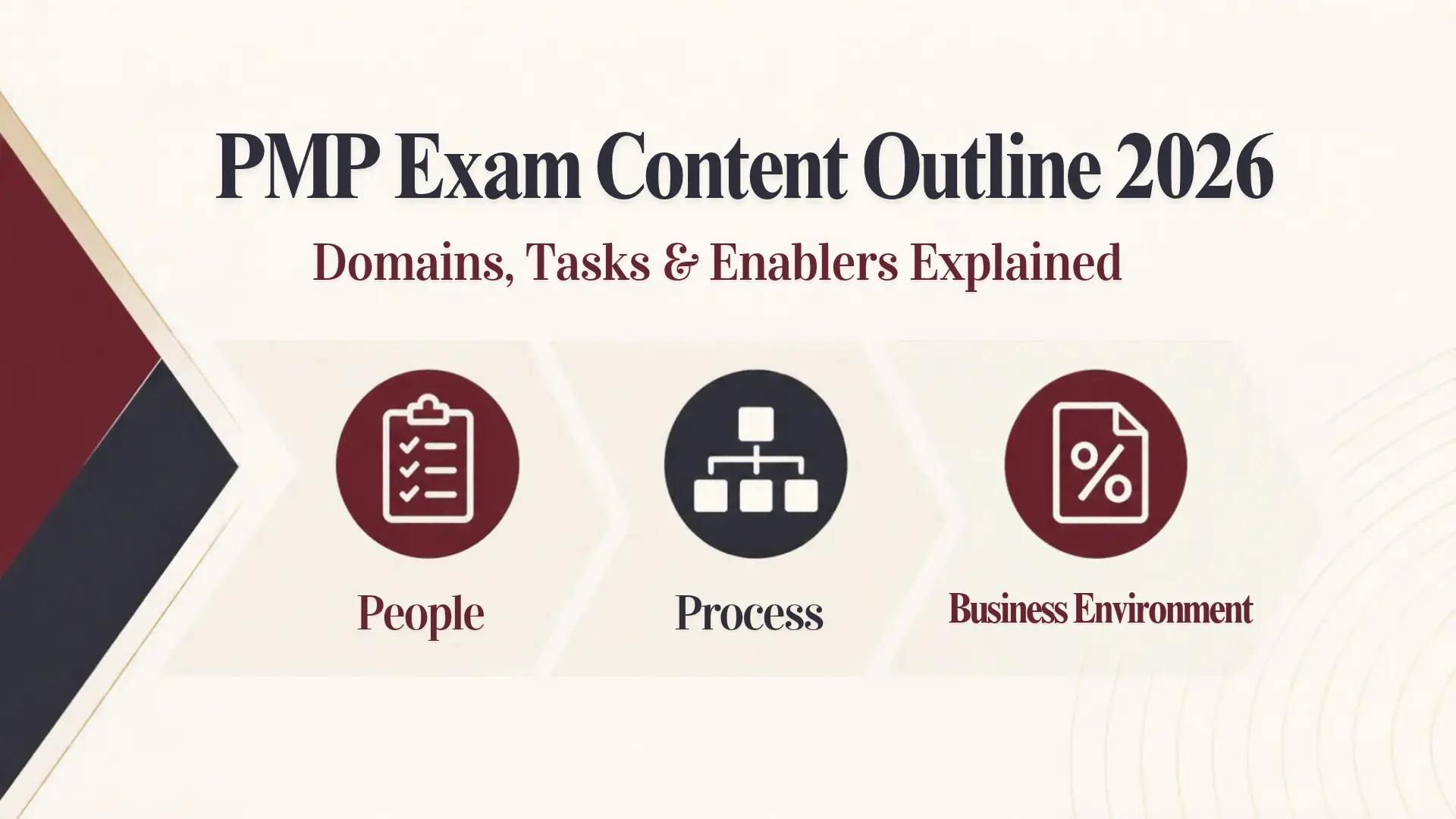
The examination is divided into three domains:
| Domain | Weight |
|---|---|
| People | 33% |
| Process | 41% |
| Business Environment | 26% |
These percentages come directly from the July 2026 PMP Examination Content Outline.
People — 33%
The People domain focuses on the human side of project leadership. It includes areas such as leadership, team development, conflict management, stakeholder engagement, communication, expectations, and knowledge transfer.
Process — 41%
Process is the largest domain. It covers the work required to plan, coordinate, deliver, monitor and close projects, including integrated planning, scope, value delivery, resources, procurement, finance, quality, schedule, project status, and closure.
Business Environment — 26%
Business Environment now represents more than one quarter of the examination. It includes areas such as governance, compliance, change, risks and issues, organizational context, external environment, and business value.
This domain increased substantially in the 2026 exam update.
For the detailed differences from the previous PMP examination, see our complete guide to the PMP exam changes in 2026.
How much of the PMP exam is agile?
This is another area where candidates often encounter misleading percentages online.
PMI states that approximately 40% of exam items represent predictive project-management approaches, and the remaining 60% is divided between adaptive/agile and hybrid approaches.
PMI does not publish a separate fixed percentage for agile versus hybrid, so claims that the PMP exam is exactly a fixed split between agile and hybrid should not be treated as official PMI weighting.
Predictive, agile and hybrid situations can also appear across the three exam domains rather than being isolated into separate sections.
This means you need to recognize the project environment from the facts in the question and apply the appropriate reasoning.
Is the PMP exam mostly scenario-based?
Candidates should expect a strong emphasis on applied and scenario-based reasoning.
PMI describes the updated examination as more interactive and scenario-based, and the ECO specifically includes case/scenario questions in the exam format.
Even a standard multiple-choice question may still describe a project situation and ask what the project manager should do first, next, or best, to prevent a problem, to resolve a problem, before escalating, or after a change occurs.
This is why memorizing definitions alone is not enough. You need to understand how project-management principles affect decisions in context.
Can you take the PMP exam online?
Yes.
PMI currently allows the PMP examination to be taken in person at a test center or online with a proctor.
PMI recommends in-person test-center delivery on its current PMP certification page.
If you choose online proctoring, you will need to satisfy the required system, identification, workspace and check-in requirements.
PMI also notes that certain interactive question types are designated specifically for CBT, so candidates should not assume that every question interface listed in the ECO appears identically across every delivery modality.
What is the PMP exam passing score in 2026?
PMI does not give candidates a simple published fixed percentage as the universal PMP exam passing score.
The current PMI Certification Handbook states that passing scores are established through psychometric analysis and that PMI certifications use a criteria-based assessment approach.
Therefore, claims that you need exactly a specific percentage to pass the PMP exam should not be treated as official PMI rules unless PMI itself publishes such a figure.
Your preparation target should instead be consistent performance across the current exam content, not trying to reverse-engineer an unofficial passing percentage.
What happens after you finish the PMP exam?
For computer-delivered PMP exams, you may receive a preliminary result when your testing session concludes.
PMI states that a PMP result provided at the end of the examination is considered preliminary until PMI confirms the official result.
Your exam reporting also provides performance information that can help identify how you performed across the assessed areas.
How should you prepare for the 2026 PMP exam format?
Knowing the content is only one part of preparation. You should also become comfortable with the way the content is tested.
1. Practice realistic situational questions
Do not rely entirely on short definition questions. Practice situations where multiple responses appear reasonable and you must identify the best action based on context.
2. Practice multi-response questions
Get used to evaluating every option instead of looking for one obvious answer.
3. Practice shared case scenarios
Read one larger scenario and answer several independent questions from it. This helps you learn how to extract relevant facts without allowing one question to influence another incorrectly.
4. Include visual interpretation
Be comfortable reading charts, diagrams, performance data and other visual information.
5. Practice under time pressure
Completing individual questions correctly is not enough. You also need the concentration and pacing necessary to work through a four-hour examination.
6. Practice predictive, agile and hybrid reasoning
Do not memorize an "agile answer" and a "predictive answer." Determine the actual environment described in the question and respond appropriately.
7. Use current 2026 material
The updated examination launched in July 2026. If an article, course, video or question bank describes older domain weights or assumes an older exam structure, check whether it has actually been updated.
If you have not yet confirmed that you qualify for PMP, start with our PMP eligibility requirements for 2026.
Once you are eligible, our step-by-step PMP application guide explains how to move from eligibility to application and scheduling.
Frequently asked questions about the PMP exam format
How many questions are on the PMP exam in 2026?
There are 180 questions. Of these, 170 are scored and 10 are unscored pretest questions.
How many hours is the PMP exam?
The exam provides 240 minutes, or four hours, to answer the 180 questions.
How many breaks are there?
There are two 10-minute breaks. The first occurs after the case-study section, while the second occurs approximately midway through the independent-question portion.
Can you return to questions after taking a break?
No. Once you complete the review for the previous section and begin the break, PMI states that you cannot return to those questions.
Are all 180 PMP exam questions scored?
No. 170 questions are scored and 10 are unscored pretest questions. You are not told which questions are pretest items.
Is the PMP exam all multiple choice?
No. The current exam may contain multiple-choice single-response, multiple-response, case/scenario, graphic-based, enhanced matching, point-and-click, matching and pull-down questions, among other possible formats.
What percentage of the PMP exam is agile?
PMI does not publish a specific agile-only percentage. Approximately 40% of the examination represents predictive approaches, and the remaining approximately 60% is divided between adaptive/agile and hybrid approaches.
What is the passing percentage for the PMP exam?
PMI does not publish a universal fixed percentage. The passing standard is established using psychometric analysis.
Can I take the PMP exam from home?
Yes. The PMP exam is available through online proctoring as well as in-person testing, subject to PMI and testing-provider requirements.
The key takeaway
The 2026 PMP exam is a 180-question, 240-minute professional certification examination designed increasingly around applied project-management judgment.
You will face more than traditional multiple-choice questions. The current format can include case studies, graphics, multiple-response questions and interactive question types. You also need to manage two scheduled breaks and understand that you cannot return to a completed section once its break begins.
At the same time, the content remains structured around three domains: People 33%, Process 41%, and Business Environment 26%. Approximately 40% of items represent predictive project management, while approximately 60% is divided between adaptive/agile and hybrid approaches.
The best way to prepare is therefore not simply to memorize more information. You need to practice interpreting situations, selecting appropriate actions, working with different question formats, and making project-management decisions under time pressure.
That is much closer to the experience the current PMP exam is designed to create.
If you want to practice scenario-based PMP questions aligned with the current July 2026 exam structure, CertOnyx's PMP certification prep covers predictive, agile and hybrid project environments.
Official sources
This guide is based primarily on current information published by the Project Management Institute:
- PMI — PMP Examination Content Outline, July 2026
- PMI — Project Management Professional certification page
- PMI — Certification Handbook
- PMI — 2026 PMP exam update
Exam policies and delivery details can change. Candidates should verify PMI's current official information before scheduling their examination.
CertOnyx is an independent exam-preparation platform and is not affiliated with, endorsed by, or sponsored by the Project Management Institute.