PMP Exam Content Outline 2026 Explained: Domains, Tasks & Enablers
Understand the PMP Exam Content Outline for 2026: domain weights, all 26 tasks, 138 enablers, predictive/agile/hybrid coverage, and how to study.
PMP Exam Content Outline 2026 Explained: Domains, Tasks & Enablers
If you are preparing for the PMP exam in 2026, one document should sit at the center of your study plan: the PMP Examination Content Outline, usually called the PMP ECO.
The ECO tells you what the Project Management Professional (PMP)® examination is designed to assess. It defines the exam domains, their percentage weights, the responsibilities or tasks candidates are expected to understand, and the enablers that illustrate the work associated with those tasks.
The current PMP Examination Content Outline became effective with the updated exam launched in July 2026.
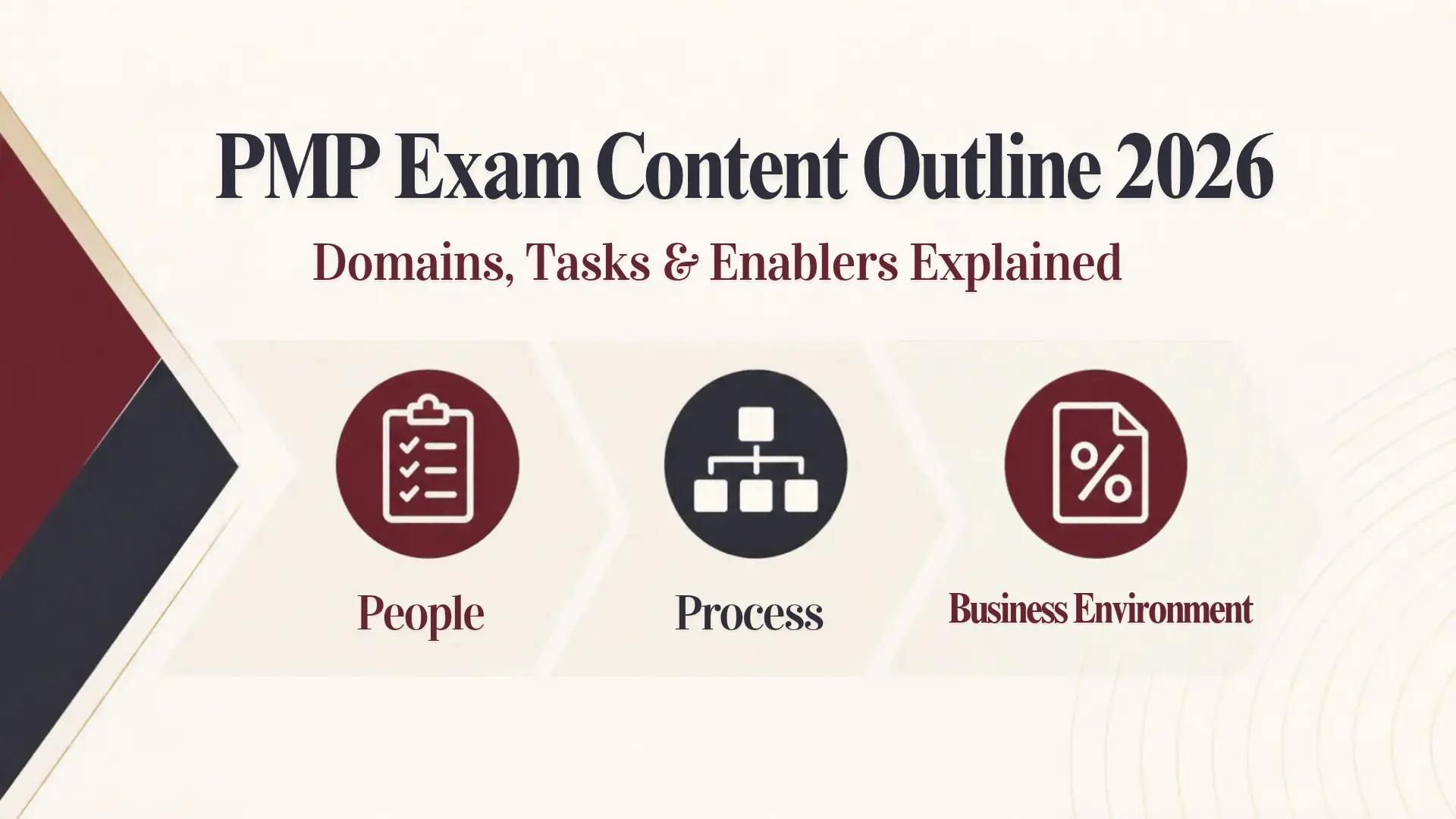
For the 2026 exam, PMI divides the content into three domains:
| PMP domain | Exam weight |
|---|---|
| People | 33% |
| Process | 41% |
| Business Environment | 26% |
| Total | 100% |
The outline contains 26 tasks across these three domains. Counting the enabler bullets published under those tasks gives 138 listed enablers.
But the ECO is more than a list to memorize.
Used correctly, it gives you a blueprint for deciding what to study, how deeply to study it, and how to recognize whether a PMP course, question bank or study plan is actually aligned with the current examination.
This guide explains the PMP Exam Content Outline 2026, including all three domains, all 26 tasks, the role of the 138 enablers, the predictive/agile/hybrid distribution, and how to turn the ECO into a practical PMP study plan.
Quick answer: The 2026 PMP exam uses three domains: People 33%, Process 41%, and Business Environment 26%. Across those domains are 26 tasks and 138 listed enablers. PMI also states that approximately 40% of exam items represent predictive approaches, while the remaining approximately 60% is divided between adaptive/agile and hybrid approaches.
What is the PMP Examination Content Outline?
The PMP Examination Content Outline is PMI's official description of the content covered by the PMP certification examination.
It is based on a job task analysis (JTA) that identifies the responsibilities and activities considered relevant to modern project-management practice.
For candidates, the most important part of the ECO is its hierarchy:
Domain → Task → Enabler
A domain is a broad area of project-management practice.
A task describes an important responsibility performed by project professionals within that domain.
An enabler provides examples of the work associated with a task.
This distinction matters because enablers are not intended to be an exhaustive checklist of everything that can appear on the exam.
They help explain what a task involves, but candidates should understand the underlying competency rather than simply memorize each bullet.
Is the PMP ECO the same as the PMBOK Guide?
No.
The PMP Examination Content Outline and the PMBOK® Guide serve different purposes.
The ECO defines what the PMP examination is intended to assess.
The PMBOK Guide provides project-management knowledge, concepts, principles, practices, methods and terminology that can support your understanding of those competencies.
PMI itself distinguishes the two.
The PMP exam is designed to assess whether candidates can apply project-management knowledge and experience to realistic work situations. It is not simply a test of whether you memorized a particular edition of the PMBOK Guide.
That is why a sound PMP study strategy should begin with the ECO and then use appropriate knowledge sources to master the competencies it identifies.
If you want the broader structure of the current examination — including 180 questions, 240 minutes, breaks and question formats — see our PMP Exam Format 2026 guide.
PMP domains and weights for 2026
The current PMP exam contains three domains:
People — 33%
People represents approximately one third of the exam.
This domain focuses on the human side of project leadership: creating alignment, leading teams, handling conflict, engaging stakeholders, managing expectations, transferring knowledge and communicating effectively.
Process — 41%
Process is the largest domain at 41%.
It covers the work required to plan and deliver projects, including integrated planning, scope, value, resources, procurement, finance, quality, schedule, project status and closure.
Business Environment — 26%
Business Environment accounts for 26% of the exam.
It addresses how projects operate within organizational and external environments, including governance, compliance, change, impediments and issues, risk, continuous improvement, organizational change and external business conditions.
One of the notable changes in the July 2026 examination is the increased emphasis on the Business Environment domain.
For a comparison with the previous examination, see our guide to the PMP exam changes in 2026.
How many tasks and enablers are in the 2026 PMP ECO?
The July 2026 content outline contains:
| Domain | Tasks | Listed enablers |
|---|---|---|
| People | 8 | 39 |
| Process | 10 | 64 |
| Business Environment | 8 | 35 |
| Total | 26 | 138 |
The task count is useful because PMI states that PMP examinations address the tasks within each domain while maintaining the published domain-level percentage coverage.
The enabler count requires an important qualification.
PMI describes enablers as illustrative examples of the work associated with a task. They are not intended to form an exhaustive list.
Therefore, do not treat the 138 enablers as 138 isolated facts to memorize.
Instead, use them to understand the scope of each task and the kinds of decisions or activities that the task can involve.
PMP People domain — 33%
The People domain contains 8 tasks.
Task 1: Develop a common vision
Candidates should understand how project leaders help stakeholders establish, promote and maintain a shared understanding of what the project is trying to achieve.
In practice, this means more than writing a vision statement. It involves recognizing misalignment and helping stakeholders maintain a common direction as circumstances change.
Task 2: Manage conflicts
Conflict management involves identifying the source and context of a conflict, selecting or supporting an appropriate resolution strategy, and maintaining working agreements that help teams collaborate effectively.
PMP situational questions often test whether you diagnose a conflict before jumping directly to escalation or authority.
Task 3: Lead the project team
This task covers team expectations, empowerment, problem solving, leadership style, roles, responsibilities and support for different skills and perspectives.
Expect leadership questions to require judgment rather than a single universal leadership technique.
Task 4: Engage stakeholders
Stakeholder engagement includes identifying and analyzing stakeholders, tailoring communication, executing engagement strategies, building trust and maintaining alignment between stakeholder needs and project objectives.
Task 5: Align stakeholder expectations
Project professionals must understand what stakeholders expect and facilitate alignment when those expectations differ.
This task emphasizes active alignment rather than simply documenting competing expectations.
Task 6: Manage stakeholder expectations
Once expectations are understood and aligned, they still need to be monitored.
The task includes maintaining outcomes against internal and external customer expectations and responding when satisfaction or expectations change.
Task 7: Help ensure knowledge transfer
Projects generate and depend on knowledge.
Candidates should understand how to identify critical knowledge, gather it and create conditions that allow knowledge to move effectively between people and groups.
Task 8: Plan and manage communication
Communication management includes establishing a communication strategy, promoting transparency and collaboration, creating feedback loops, understanding reporting requirements and supporting governance.
The People domain therefore extends well beyond traditional "soft skills." It tests practical leadership decisions that affect delivery.
PMP Process domain — 41%
The Process domain contains 10 tasks and is the largest domain on the exam.
Task 1: Develop an integrated project management plan and plan delivery
This task brings together project needs, complexity, development approach, execution strategy, resource requirements, dependencies and business value.
Candidates should be able to reason about the project as an integrated system rather than treating each plan independently.
Task 2: Develop and manage project scope
Scope management includes defining scope, obtaining stakeholder agreement and breaking the scope down into manageable work.
The exact techniques may differ according to the delivery approach.
Task 3: Help ensure value-based delivery
The PMP exam increasingly emphasizes value, not simply completion of outputs.
Candidates need to understand how to identify value, prioritize work, deliver value incrementally where appropriate, measure benefits and reconsider delivery options as the project evolves.
Task 4: Plan and manage resources
This task addresses defining, planning and optimizing the resources required by the project.
It includes reasoning about both requirements and availability rather than treating resource planning as a one-time exercise.
Task 5: Plan and manage procurement
Procurement covers planning, contract considerations, vendor evaluation, negotiations, supplier management and delivery solutions.
PMP questions in this area can require you to choose actions based on commercial context rather than memorize simplistic rules about which party "owns" all risk.
Task 6: Plan and manage finance
The 2026 ECO explicitly includes project financial needs, financial allocations for risk and contingency, spending, reporting, financial variation and reserves.
Candidates should therefore be comfortable interpreting project financial information as part of management decision-making.
Task 7: Plan and optimize quality of products/deliverables
Quality work includes requirements, quality processes, regulatory considerations, cost of quality, reviews and continuous improvement.
The emphasis is not merely on detecting defects after delivery but on designing and managing quality throughout the work.
Task 8: Plan and manage schedule
Schedule management includes estimating, dependencies, milestones, historical information, schedule creation, baselines where appropriate, execution and schedule variation.
The selected development approach affects how scheduling is performed.
Task 9: Evaluate project status
Candidates need to understand how metrics and artifacts help assess progress and support informed decisions.
This includes creating and maintaining appropriate artifacts, analyzing performance information and communicating project status.
Task 10: Manage project closure
Closure includes confirming completion, validating transition readiness and concluding the activities required to close a project or phase.
Closure remains important even when the project uses adaptive ways of working.
PMP Business Environment domain — 26%
The Business Environment domain contains 8 tasks.
At 26%, it now represents more than one quarter of the examination.
Task 1: Define and establish project governance
Governance determines how decisions, reporting, escalation, policies and success criteria operate around a project.
Candidates should understand how governance provides decision boundaries rather than confusing governance with day-to-day project management.
Task 2: Plan and manage project compliance
Projects may need to satisfy regulatory, security, health and safety, sustainability or other compliance requirements.
The project professional must identify those requirements, understand the consequences of noncompliance, support appropriate action and monitor compliance throughout the project.
Task 3: Manage and control changes
Change control involves evaluating and processing change, communicating its status, implementing approved changes and keeping project information consistent with those decisions.
The appropriate control mechanism can vary by context and delivery approach.
Task 4: Remove impediments and manage issues
Candidates need to distinguish risks from issues and understand how to evaluate, prioritize and resolve impediments that are already affecting delivery.
This can involve collaboration with stakeholders rather than simply escalating every obstacle.
Task 5: Plan and manage risk
Risk management includes identifying, analyzing, monitoring and responding to uncertainty.
The ECO also connects risk with areas such as security and sustainability, reinforcing that risk management must reflect the actual project environment.
Task 6: Continuous improvement
This task includes lessons learned, improvement processes and organizational process assets.
Continuous improvement is not something reserved for agile projects. It is a general project-management competency.
Task 7: Support organizational change
Projects frequently change how organizations operate.
Candidates should understand how organizational culture affects change and how the impact of change may require specific project actions.
Task 8: Evaluate external business environment changes
Projects do not operate in isolation.
External changes involving regulation, technology, markets, geopolitics or similar factors can affect scope, backlog, priorities and project decisions.
The project professional must continue monitoring those changes rather than performing a one-time environmental analysis.
What do PMP enablers mean?
Enablers are one of the most misunderstood parts of the PMP ECO.
They are not separate exam domains.
They are also not a set of individually weighted mini-topics.
An enabler is an example of the work associated with a task.
For example, a task such as managing risk can contain enablers related to identifying risk, analyzing it, monitoring it, maintaining risk information, executing responses and communicating risk status.
Together, those examples illustrate the competency represented by the task.
This gives you a better way to use the ECO:
Do not ask, "Have I memorized this enabler?"
Ask:
"Could I recognize this situation in a project scenario and make an appropriate decision?"
That is much closer to the reasoning the PMP exam is designed to assess.
Does PMI publish the number of questions per PMP task?
No.
PMI publishes percentages at the domain level:
- People: 33%
- Process: 41%
- Business Environment: 26%
It does not publish an official number of questions for each individual task or enabler.
Therefore, a study provider that claims an exact official PMI percentage for a specific task or enabler should be treated cautiously unless PMI has actually published that number.
The safest approach is to use the domain weights as official weighting guidance while ensuring that your preparation covers the full set of tasks and their associated competencies.
Predictive, agile and hybrid coverage in the 2026 ECO
The PMP ECO is not divided into a "predictive section" and an "agile section."
PMI states that approximately 40% of exam items represent predictive project-management approaches.
The remaining approximately 60% is divided between adaptive/agile and hybrid approaches.
PMI does not publish an exact split between agile and hybrid.
These approaches can appear throughout all three domains.
That means a People question can be predictive, agile or hybrid.
A Process question can be predictive, agile or hybrid.
A Business Environment question can also require decisions in different delivery contexts.
This is why memorizing separate lists of "agile answers" and "predictive answers" is a weak PMP strategy.
You need to identify the environment described in the scenario and apply project-management reasoning that fits that environment.
Where do AI and sustainability fit in the 2026 PMP exam?
PMI explains that trends such as artificial intelligence and sustainability were considered when updating the job task analysis behind the 2026 examination.
That does not mean there is a separate "AI domain" or "sustainability domain."
Instead, these subjects can appear where they are relevant to project-management responsibilities.
For example, sustainability can influence planning, quality, risk, compliance, business value and delivery decisions.
Technology changes, including AI, can also affect the external business environment and the way projects are planned or delivered.
The important lesson is to understand these issues in project context rather than memorize isolated technology terminology.
How to use the PMP ECO to build your study plan
The ECO becomes much more useful when you turn it into a study-control tool.
1. Start with the three domain weights
Allocate your overall study effort with the official weights in mind.
Process deserves substantial attention at 41%, but Business Environment cannot be treated as a minor afterthought at 26%.
2. Check every task
Create a checklist of all 26 tasks.
For each one, ask whether you can:
- explain the competency;
- recognize it in a realistic project situation;
- distinguish appropriate and inappropriate actions;
- apply it in predictive, agile or hybrid contexts where relevant.
3. Use enablers to identify gaps
Once you understand a task, use its enablers as diagnostic prompts.
If one enabler exposes a concept you cannot explain or apply, that is a useful study gap.
4. Study relationships, not isolated definitions
Many difficult PMP questions sit at the boundary between concepts.
Examples include:
- risk versus issue;
- stakeholder engagement versus communication;
- approved change versus proposed change;
- project governance versus project management;
- value delivery versus output delivery;
- contingency versus management decisions;
- adaptive flexibility versus uncontrolled change.
Understanding those relationships is usually more useful than memorizing definitions independently.
5. Practice scenario-based decisions
The current examination emphasizes application.
Once you study a task, practice questions that require you to make a decision in context.
Ask:
- What should happen first?
- What information is missing?
- Who owns the decision?
- Which process or governance mechanism applies?
- Does the delivery approach change the answer?
- Is the situation a risk, issue, change, conflict or stakeholder problem?
6. Track weak areas by domain and task
Your practice data should eventually tell you more than your overall percentage score.
If you consistently miss questions involving governance, stakeholder expectations or financial reserves, your study plan should respond to those specific weaknesses.
How to tell whether a PMP course or question bank is aligned with the 2026 ECO
Before relying heavily on a PMP resource, check whether it reflects the July 2026 Examination Content Outline.
Look for:
- People at 33%;
- Process at 41%;
- Business Environment at 26%;
- the current task structure;
- predictive, adaptive/agile and hybrid reasoning;
- meaningful Business Environment coverage;
- current case/scenario-oriented preparation;
- updated treatment of areas such as value, governance, finance, compliance and external change.
An old course can still contain useful project-management knowledge.
But if its exam blueprint is based on an older ECO, it should not be your only preparation resource for the current examination.
Our guide to the PMP exam changes in 2026 explains the major differences in more detail.
Should you memorize all 138 PMP enablers?
Not word for word.
You should know what the enablers represent and make sure that the competencies behind them are covered in your preparation.
But memorizing 138 sentences without understanding the underlying project decisions is unlikely to prepare you well for scenario-based questions.
A better sequence is:
- understand the domain;
- understand each task;
- use its enablers to map the scope of the task;
- learn the project-management concepts required to perform that work;
- practice applying them in realistic situations.
That approach turns the ECO from a memorization document into a useful study blueprint.
Frequently asked questions about the PMP ECO 2026
What is the PMP ECO?
ECO stands for Examination Content Outline.
It is PMI's official description of the domains, tasks and enablers that define the scope of the PMP certification examination.
What are the three PMP domains in 2026?
The three domains are:
- People — 33%
- Process — 41%
- Business Environment — 26%
How many tasks are in the 2026 PMP Exam Content Outline?
There are 26 tasks:
- 8 People tasks;
- 10 Process tasks;
- 8 Business Environment tasks.
How many enablers are in the PMP ECO 2026?
Counting the listed enabler bullets in the July 2026 outline gives 138 enablers:
- 39 People;
- 64 Process;
- 35 Business Environment.
Enablers are illustrative rather than exhaustive.
Does every PMP task have an official percentage?
No.
PMI publishes the exam percentage at the domain level, not an official percentage for every individual task or enabler.
Is the PMP exam based only on the PMBOK Guide?
No.
The exam is based on the competencies defined by the PMP Examination Content Outline.
The PMBOK Guide is an important project-management knowledge source, but preparing for PMP requires understanding how to apply project-management concepts in the situations described by the ECO.
What percentage of the PMP exam is agile?
PMI does not publish a fixed agile-only percentage.
Approximately 40% of exam items represent predictive approaches. The remaining approximately 60% is divided between adaptive/agile and hybrid approaches.
Do I need to memorize all PMP enablers?
You should understand the competencies represented by the enablers, but memorizing their wording is not the objective.
Use them to identify the scope of each task and then practice applying the underlying concepts.
The key takeaway
The PMP Exam Content Outline 2026 should be one of the main documents guiding your PMP preparation.
It tells you how the examination is structured around:
- 3 domains
- 26 tasks
- 138 listed enablers
- People: 33%
- Process: 41%
- Business Environment: 26%
It also makes clear that project-management approaches are integrated across the examination, with approximately 40% predictive and the remaining approximately 60% divided between adaptive/agile and hybrid.
The most useful way to study the ECO is not to memorize it line by line.
Use it as a coverage map.
Understand each task, use its enablers to identify the competency boundaries, and then practice applying that knowledge to realistic project situations.
If you have not yet looked at the practical structure of the examination itself, read our complete PMP Exam Format 2026 guide.
If you are earlier in the certification journey, you can also review the PMP eligibility requirements for 2026 and our guide on how to apply for the PMP exam in 2026.
For scenario-based practice aligned with the current exam, explore CertOnyx PMP certification prep.
Official source
This guide is based primarily on:
Project Management Institute — PMP Certification Exam Content Outline, July 2026
Candidates should always verify current exam information directly with PMI before scheduling or sitting for the examination.