How to Study for the PMP Exam in 2026: A Step-by-Step Strategy
Learn how to study for the PMP exam in 2026 with a practical strategy covering the ECO, PMBOK 8, scenario questions, agile/hybrid, mock exams, and review.
Preparing for the PMP exam in 2026 requires more than reading a project management book and memorizing definitions.
The current PMP exam is designed to test whether you can apply project management knowledge in realistic situations. You need to recognize what is happening in a scenario, identify the relevant project-management principle or process, and choose the most appropriate action.
That changes how you should study.
A strong PMP preparation strategy should combine:
- the current PMP Examination Content Outline;
- project-management concepts and terminology;
- predictive, agile and hybrid delivery approaches;
- scenario-based practice questions;
- regular review of mistakes;
- timed mock exams;
- focused revision of weak areas.
This guide explains how to study for the PMP exam in 2026 step by step, from your first study session to final exam preparation.
Quick answer: Start with the current PMP Examination Content Outline, build your conceptual foundation, learn how predictive, agile and hybrid approaches differ, practice scenario-based questions every week, analyze every mistake, and gradually move toward timed mock exams. Do not make memorization your primary study method.
Understand the PMP exam before you start studying
Before opening a textbook or answering hundreds of questions, understand what exam you are preparing for.
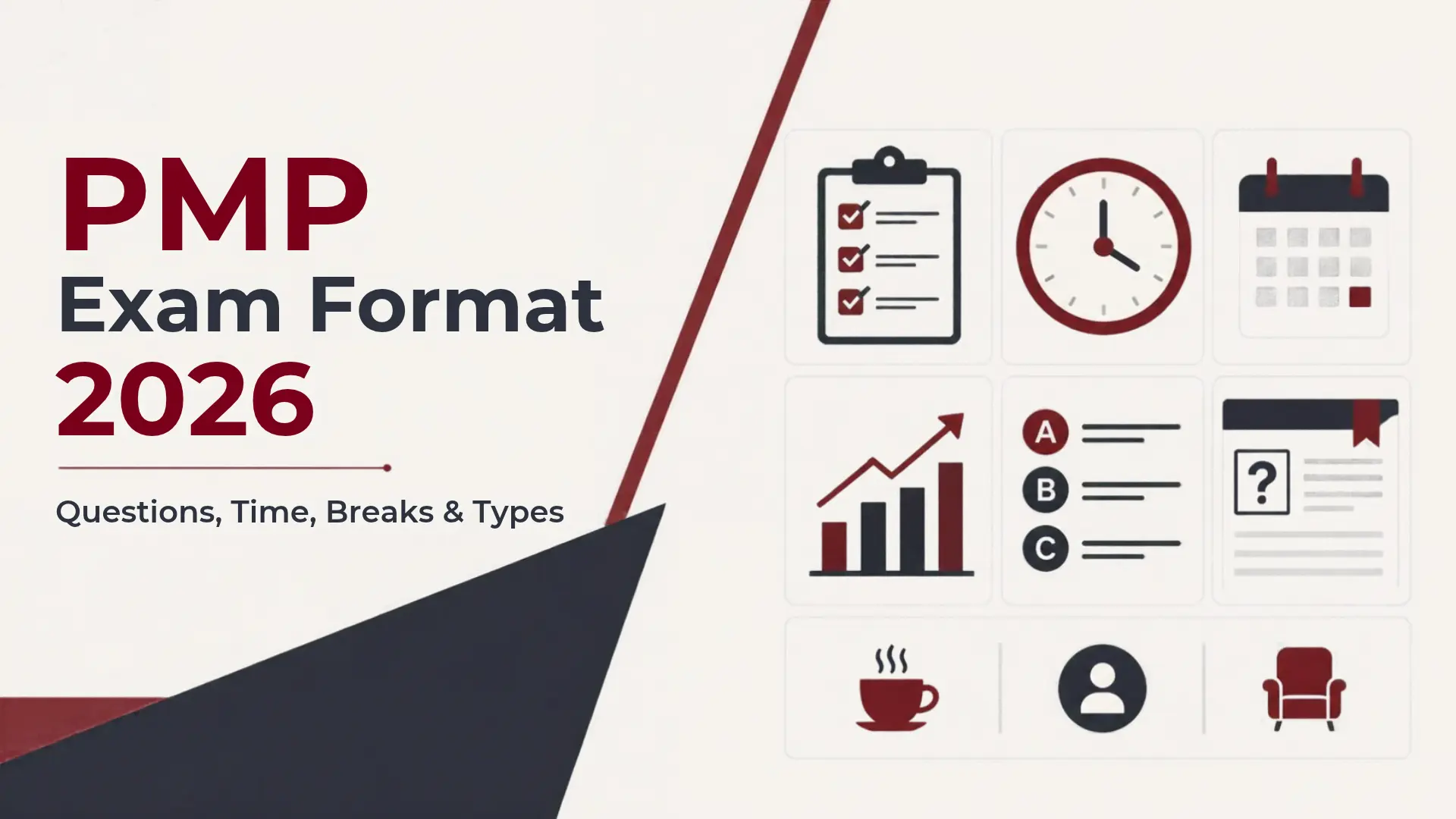
The current PMP exam contains:
- 180 questions
- 240 minutes
- 170 scored questions
- 10 unscored pretest questions
- two 10-minute breaks
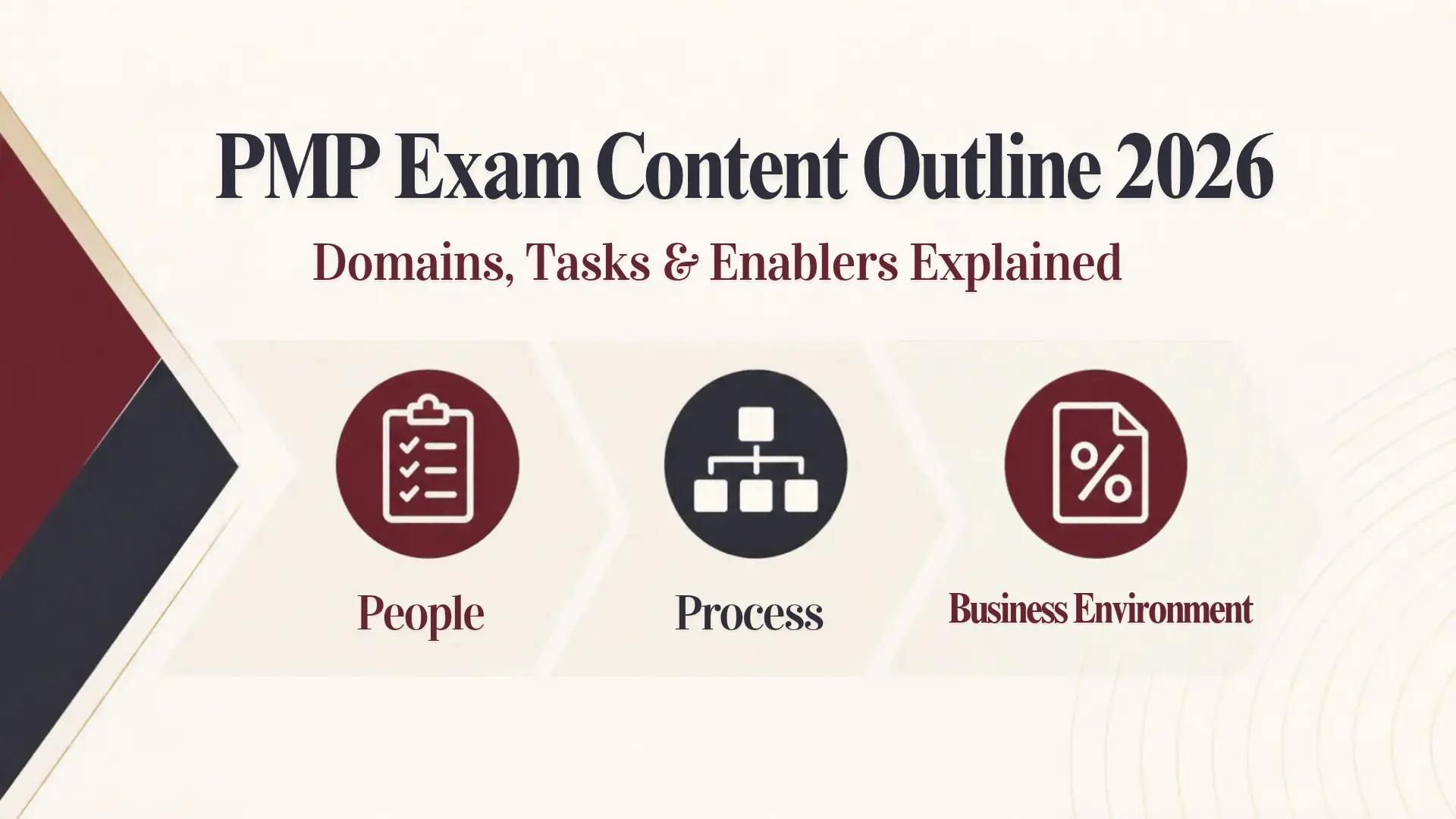
The July 2026 exam is organized around three domains:
| Domain | Exam weight |
|---|---|
| People | 33% |
| Process | 41% |
| Business Environment | 26% |
PMI also states that approximately 40% of exam items represent predictive approaches, while the remaining approximately 60% is divided between adaptive/agile and hybrid approaches.
That means you should not prepare for PMP as though it were only a traditional predictive project-management exam.
Agile and hybrid thinking need to be integrated into your preparation from the beginning.
For the full exam structure, question types and break rules, see our PMP Exam Format 2026 guide.
Step 1: Use the PMP Examination Content Outline as your study map
One of the biggest mistakes candidates make is studying from a collection of resources without knowing what the exam is actually designed to assess.
Your starting point should be the current PMP Examination Content Outline, or ECO.
The 2026 ECO organizes the exam into:
- 3 domains
- 26 tasks
- 138 listed enablers
The hierarchy is:
Domain → Task → Enabler
You do not need to memorize every enabler word for word.
Instead, use the ECO as a coverage checklist.
For every task, ask yourself:
- Do I understand what this responsibility means?
- Can I recognize it in a project scenario?
- Do I know what information a project manager should gather?
- Do I understand who should be involved?
- Can I distinguish an appropriate next action from a premature one?
- Would my answer change in a predictive, agile or hybrid environment?
Our PMP Exam Content Outline 2026 guide explains all three domains and all 26 tasks in detail.
Step 2: Build understanding before trying to memorize
The PMP exam contains terminology you need to know, but pure memorization is not enough.
Consider these pairs:
- risk vs issue;
- corrective action vs preventive action;
- project governance vs project management;
- stakeholder engagement vs communication;
- quality assurance vs inspection;
- contingency reserve vs management reserve;
- approved change vs proposed change;
- predictive planning vs adaptive planning.
Knowing the definitions helps.
But PMP questions often ask you to identify which concept applies inside a situation.
For example, instead of asking:
What is a risk?
you may see a scenario in which an uncertain future event has been identified and the project manager must decide what to do next.
You need to recognize that the situation is a risk, understand the relevant process, and choose the appropriate response.
That is why you should study concepts in relationships rather than as isolated definitions.
Step 3: Learn the project-management logic behind PMP questions
A useful way to study PMP is to ask not only what the correct action is, but why it should happen at that point in the scenario.
Many PMP questions are fundamentally sequencing questions.
Common patterns include:
Understand before acting.
Before implementing a solution, determine what is actually causing the problem.
Analyze before escalating.
Escalation may be necessary, but it is rarely the automatic first response.
Collaborate before imposing.
Many stakeholder and team problems should first be addressed through communication, facilitation or collaboration.
Follow governance.
Changes, approvals, compliance requirements and major decisions should follow the project's established governance structure.
Protect value.
The objective is not merely to complete activities. The project should continue to support intended value and outcomes.
These are not universal answer formulas. Context still matters.
But learning to identify the logic behind a decision is far more useful than trying to memorize lists of supposed "PMP tricks."
Step 4: Study predictive, agile and hybrid approaches together
Do not study predictive project management for several weeks and then treat agile as a separate chapter at the end.
The current PMP exam integrates delivery approaches throughout the domains.
You should therefore become comfortable asking:
What type of environment am I in?
In a predictive environment, you may see:
- defined scope;
- detailed upfront planning;
- formal baselines;
- formal change control;
- sequential delivery;
- planned milestones.
In an adaptive or agile environment, you may see:
- evolving requirements;
- prioritized backlog;
- iterative delivery;
- frequent stakeholder feedback;
- self-managing teams;
- short feedback cycles.
A hybrid environment combines elements of both.
The exam may describe a project without explicitly telling you:
This is a hybrid project.
You may have to infer it from the scenario.
A good study method is therefore to take the same topic and ask how it works under different approaches.
For example:
Change
- How is change handled in a predictive environment?
- How does an adaptive team respond to evolving requirements?
- How might a hybrid project combine formal governance with iterative delivery?
Do this for:
- scope;
- schedule;
- risk;
- quality;
- stakeholder engagement;
- communication;
- procurement;
- value delivery;
- change;
- governance.
Step 5: Focus heavily on scenario-based questions
Reading explains concepts.
Questions teach you to recognize and apply them.
Once you understand a topic, begin practicing questions immediately.
Do not wait until you have "finished studying everything."
A productive cycle is:
Learn → Practice → Review → Correct → Practice again
For example, after studying stakeholder engagement:
- review the concepts;
- answer 10–20 stakeholder scenarios;
- analyze your wrong answers;
- identify the reasoning error;
- review the relevant concept;
- answer additional questions later.
This creates active learning rather than passive reading.
Step 6: Learn how to read PMP situational questions
PMP questions often contain more information than you need.
Your job is to identify the information that changes the decision.
When reading a scenario, look for:
What has already happened?
Has the issue already occurred?
Is it still a risk?
Has a change already been approved?
Has a stakeholder already rejected something?
The status of the situation can completely change the answer.
What development approach is being used?
Predictive?
Agile?
Hybrid?
The correct response may depend on the delivery context.
What is the actual problem?
A team conflict?
A communication failure?
An unidentified risk?
An issue?
A change?
A compliance problem?
A governance decision?
Do not choose an answer before identifying the underlying problem.
What is the question asking?
Watch carefully for words such as:
- first
- next
- best
- most likely
- should have done
- should do
Several options may describe reasonable actions, but only one may be appropriate at that point in the sequence.
We will cover this topic more deeply in the upcoming guide on How to Answer PMP Situational Questions.
Step 7: Review every wrong answer properly
The value of a practice question is not the score.
The value is what you learn from your reasoning.
When you get a question wrong, do not simply read the correct option and move on.
Classify the mistake.
Was it because:
- you did not know the concept?
- you misread the scenario?
- you confused a risk with an issue?
- you chose a valid action at the wrong time?
- you missed the delivery approach?
- you escalated too early?
- you ignored governance?
- you misunderstood the role of the project manager?
- you changed the answer without a strong reason?
Keep a simple error log.
For each important mistake, record:
| Question issue | What I misunderstood | Correct reasoning |
|---|---|---|
| Risk scenario | Treated risk as issue | Event had not occurred yet |
| Stakeholder conflict | Escalated immediately | Analyze and engage first |
| Change request | Implemented before approval | Follow change control first |
After a few hundred questions, patterns will emerge.
Those patterns tell you what to study next.
Step 8: Do not judge progress only by your overall score
Suppose you score 72% on a practice test.
That number alone does not tell you enough.
You need to know where the 28% came from.
Track performance by areas such as:
- People;
- Process;
- Business Environment;
- stakeholder management;
- conflict;
- risk;
- schedule;
- cost/finance;
- quality;
- procurement;
- governance;
- change;
- agile;
- predictive;
- hybrid.
A candidate scoring 72% overall but repeatedly failing Business Environment questions has a different study problem from someone scoring 72% because of calculation errors.
Your review should become more targeted as your preparation progresses.
Step 9: Use mock exams later, not too early
Full mock exams are important, but they are most useful after you have built a reasonable knowledge base.
Taking a four-hour mock exam during your first week may tell you that you are not prepared yet — something you already knew.
Early in your preparation, use shorter topic-based and mixed-question sessions.
As you improve, gradually introduce:
- 30-question sets;
- 60-question sets;
- mixed-domain quizzes;
- timed sessions;
- full-length simulations.
Full mock exams are especially useful for testing:
- concentration;
- time management;
- pacing;
- decision fatigue;
- break strategy;
- ability to recover after difficult questions.
The real exam gives you 240 minutes for 180 questions, so pacing should eventually become part of your preparation.
Step 10: Develop an exam-time pacing strategy
Four hours sounds generous until you are working through complex scenario questions.
A simple average is approximately 80 seconds per question.
That does not mean every question should take exactly 80 seconds.
Some may take 20 seconds.
Others may require several minutes.
The objective is to avoid spending excessive time on a few difficult questions.
During timed practice, learn to recognize when additional thinking is no longer improving your answer.
Make the best decision you can, mark the question for review when appropriate, and continue.
The exam contains two scheduled 10-minute breaks, so practice managing your energy as well as your time.
Step 11: Study formulas by understanding what they mean
PMP preparation still includes quantitative concepts, but formulas should not be treated as meaningless equations.
When you learn a formula, understand:
- what the variables represent;
- what the result tells you;
- how to interpret values above or below a reference point;
- what management decision the result could support.
For example, knowing that:
CPI = EV / AC
is useful.
But you should also understand what a CPI below 1.0 implies about cost performance.
Likewise, do not memorize schedule or earned-value formulas without understanding the business meaning of the result.
We will cover these concepts separately in our upcoming PMP Formulas Cheat Sheet and Earned Value Management guides.
Step 12: Use PMBOK 8 as a knowledge source, not a memorization target
The PMBOK Guide is valuable for understanding project-management concepts, principles, methods and terminology.
But your objective should not be:
Memorize the PMBOK Guide from beginning to end.
Instead, use it as part of your knowledge foundation.
When a practice question exposes a weakness in:
- governance;
- risk;
- stakeholders;
- schedule;
- cost;
- quality;
- resources;
- value;
- development approach;
- measurement;
return to authoritative material and strengthen your understanding of that area.
Think of the ECO as the exam map and project-management references as the knowledge required to navigate that map.
Step 13: Do not ignore Business Environment
Business Environment represents 26% of the current PMP exam.
That is more than one quarter of the examination.
Candidates who studied for older versions of PMP may be tempted to spend most of their time on People and traditional Process topics.
That is risky for the 2026 exam.
Make sure your preparation includes:
- governance;
- compliance;
- change control;
- issues and impediments;
- risk;
- continuous improvement;
- organizational change;
- external business environment changes.
The current ECO gives these responsibilities substantial weight.
Step 14: Practice identifying the best answer, not merely a possible answer
One of the hardest parts of PMP questions is that several options may sound reasonable.
Imagine a stakeholder is dissatisfied.
Possible actions might include:
- update a document;
- meet the stakeholder;
- escalate to the sponsor;
- review the engagement strategy.
All four actions could be appropriate under some circumstances.
The exam asks you to determine which action best fits this particular situation and this particular moment.
When reviewing questions, ask:
Why is the correct option better than each distractor?
Do not stop at:
This option is correct.
Understanding why the others are less appropriate is where much of the learning happens.
Step 15: Reduce passive study as the exam gets closer
At the beginning of preparation, you may spend more time learning concepts.
Closer to the exam, the balance should shift toward application.
A useful progression is:
Early preparation
More:
- concept learning;
- terminology;
- structured reading;
- domain/task mapping.
Less:
- long mock exams.
Middle preparation
More:
- topic-based questions;
- mixed questions;
- mistake analysis;
- weak-area revision.
Final preparation
More:
- timed questions;
- mixed-domain scenarios;
- mock exams;
- targeted revision;
- error-log review.
Less:
- starting completely new study resources.
Changing courses, books and question banks continuously can create the illusion of progress without allowing enough repetition to develop mastery.
How many PMP practice questions should you answer?
There is no official PMI number of practice questions that guarantees success.
Quality matters more than an arbitrary target.
A candidate who carefully studies 800 well-designed questions and analyzes every mistake may learn more than someone who rushes through 3,000 questions without reviewing the reasoning.
Your objective is not to accumulate question counts.
It is to reach the point where you can:
- identify the problem quickly;
- recognize the project context;
- eliminate weak distractors;
- explain why the best answer is best;
- maintain that reasoning under time pressure.
Use your scores and error patterns to determine whether you need more practice.
How long should you study for the PMP exam?
There is no single ideal duration.
Your preparation time depends on:
- your project-management experience;
- familiarity with agile and predictive approaches;
- available weekly study time;
- prior training;
- practice-question performance;
- exam date.
Someone actively managing complex projects may require less conceptual review than someone whose experience is concentrated in one narrow area.
The important factor is not simply the number of weeks.
It is whether your preparation covers the current ECO and whether your practice performance shows consistent understanding.
In the next article in this series, we will provide a complete 8-week PMP study plan for candidates who want a structured schedule.
What should you avoid when studying for PMP?
Several study habits repeatedly create problems.
Memorizing answer patterns
Rules such as:
Never escalate.
or:
Always talk to the team first.
are dangerous.
Sometimes escalation is correct.
Sometimes the team is not the right party to consult.
The scenario determines the action.
Using outdated exam material
Older material can still teach useful project-management concepts, but the exam blueprint has changed.
Make sure your primary preparation reflects the July 2026 PMP Examination Content Outline.
You can review the major differences in our PMP Exam Changes 2026 guide.
Memorizing questions
If you begin recognizing the wording of a practice question instead of solving the problem, the question is no longer measuring your understanding.
Use varied practice.
Ignoring explanations after correct answers
You can reach the correct answer for the wrong reason.
Review explanations for difficult questions even when you answered correctly.
Studying only your favorite topics
Candidates naturally spend more time on areas they enjoy.
Your practice data should decide what deserves additional study.
A practical PMP study workflow
A simple repeatable study session might look like this:
1. Choose one competency.
Example: risk management.
2. Review the concept.
Understand risk identification, analysis, response, monitoring and communication.
3. Compare approaches.
Consider how risk work may appear in predictive, agile and hybrid contexts.
4. Answer 15–25 questions.
Avoid looking at answers until you finish each question.
5. Review every difficult question.
Correct and incorrect.
6. Update your error log.
Record recurring reasoning problems.
7. Review again several days later.
Use spaced repetition rather than one-time exposure.
Repeat this cycle across the ECO.
How to know when you are getting closer to exam readiness
No single mock score guarantees that you will pass the PMP exam.
Instead, look for several signs together.
You should increasingly be able to:
- complete mixed-question sessions within reasonable time;
- identify the domain or underlying issue in a scenario;
- distinguish risks, issues, changes and impediments;
- adapt reasoning to predictive, agile and hybrid environments;
- explain why incorrect options are weaker;
- maintain performance across longer sessions;
- avoid repeating the same reasoning mistakes;
- perform consistently across all three domains.
Consistency matters more than one unusually high practice score.
Frequently asked questions about studying for the PMP exam
What is the best way to study for the PMP exam in 2026?
Start with the current PMP Examination Content Outline, build your project-management knowledge, practice scenario-based questions, review mistakes systematically, and introduce timed mock exams as your preparation progresses.
Should I read the entire PMBOK Guide before doing practice questions?
You do not need to postpone practice questions until you have finished every reference.
A better approach is to combine concept study with relevant practice questions and return to authoritative material when questions reveal gaps.
Is the PMP exam mostly agile now?
No.
PMI states that approximately 40% of exam items represent predictive approaches, while the remaining approximately 60% is divided between adaptive/agile and hybrid approaches.
PMI does not publish an exact agile-only percentage.
Do I need to memorize all 138 PMP enablers?
No.
You should understand the competencies they illustrate and use them as a coverage map, but memorizing their wording is not the goal.
Should I memorize the PMBOK Guide?
No.
You need to understand and apply project-management concepts rather than reproduce book text.
Are practice questions enough to pass PMP?
Practice questions are essential, but they work best when combined with strong conceptual understanding and careful review of mistakes.
Simply answering large numbers of questions without learning from them is inefficient.
How many hours a day should I study for PMP?
There is no universal number.
Consistency is generally more useful than occasional long study sessions.
Choose a weekly schedule you can sustain and adjust it according to your practice performance and exam date.
When should I start full PMP mock exams?
Start them after you have covered the major exam areas and can handle shorter mixed-question sets reasonably well.
Mocks are most valuable when they test exam endurance and identify remaining weaknesses rather than introduce basic concepts for the first time.
Final PMP study strategy
If you remember only one thing from this guide, remember this:
Study for decisions, not definitions.
Use the PMP ECO to determine what you need to cover.
Build enough project-management knowledge to understand those competencies.
Then practice applying that knowledge repeatedly in realistic scenarios.
A strong 2026 PMP preparation process looks like this:
ECO → Learn → Practice → Analyze → Correct → Repeat → Simulate
Do that consistently across:
- People;
- Process;
- Business Environment;
- predictive approaches;
- agile approaches;
- hybrid environments.
That will prepare you much better than trying to memorize hundreds of isolated rules.
If you are still learning the structure of the examination itself, start with our PMP Exam Format 2026 guide.
To understand exactly what the exam covers, read the PMP Exam Content Outline 2026 guide.
You can also review the PMP eligibility requirements for 2026 and our step-by-step guide on how to apply for the PMP exam in 2026.
When you are ready to practice, explore CertOnyx PMP certification prep.
Official source
The exam-structure and content-distribution information in this guide is based on:
Project Management Institute — PMP Certification Exam Content Outline, July 2026
Candidates should always verify current PMP exam information directly with PMI before sitting for the examination.